

Đề đánh giá năng lực - Kì thi trung học phổ thông năm 2017 - Đề thi số 12 (Có đáp án)
ĐỀ THI GỒM 50 CÂU (TỪ QUESTION 1 ĐẾN QUESTION 50)
Mark the letter A, B, C, or D on your answer sheet to indicate the word that is closest in meaning to the underlined part in each of the following questions.
Question 1. The aircraft carrier is indispensable in naval operations against sea or shore based enemies.
A. unique B. novel C. exotic D. vital
Question 2. The use of lasers in surgery has become relatively commonplace in recent years.
A. absolutely B. relevantly C. almost D. comparatively
 15 trang
31/12/2025
840
15 trang
31/12/2025
840
Bạn đang xem tài liệu "Đề đánh giá năng lực - Kì thi trung học phổ thông năm 2017 - Đề thi số 12 (Có đáp án)", để tải tài liệu gốc về máy hãy click vào nút Download ở trên.
Tóm tắt nội dung tài liệu: Đề đánh giá năng lực - Kì thi trung học phổ thông năm 2017 - Đề thi số 12 (Có đáp án)
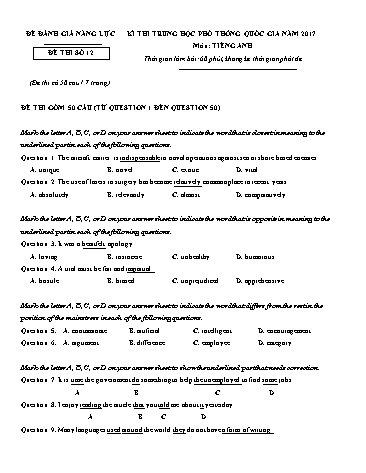
 ĐỀ ĐÁNH GIÁ NĂNG LỰC KÌ THI TRUNG HỌC PHỔ THÔNG QUỐC GIA NĂM 2017
 Môn: TIẾNG ANH
 ĐỀ THI SỐ 12
 Thời gian làm bài: 60 phút, không kể thời gian phát đề
 (Đề thi có 50 câu / 7 trang)
ĐỀ THI GỒM 50 CÂU (TỪ QUESTION 1 ĐẾN QUESTION 50)
Mark the letter A, B, C, or D on your answer sheet to indicate the word that is closest in meaning to the
underlined part in each of the following questions.
Question 1. The aircraft carrier is indispensable in naval operations against sea or shore based enemies.
 A. unique B. novel C. exotic D. vital
Question 2. The use of lasers in surgery has become relatively commonplace in recent years.
 A. absolutely B. relevantly C. almost D. comparatively
Mark the letter A, B, C, or D on your answer sheet to indicate the word that is opposite in meaning to the
underlined part in each of the following questions.
Question 3. It was a heartfelt apology.
 A. loving B. insincere C. unhealthy D. humorous
Question 4. A trial must be fair and impartial.
 A. hostile B. biased C. unprejudiced D. apprehensive
Mark the letter A, B, C, or D on your answer sheet to indicate the word that differs from the rest in the
position of the main stress in each of the following questions.
Question 5. A. contaminate B. artificial C. intelligent D. encouragement
Question 6. A. argument B. difference C. employee D. category
Mark the letter A, B, C, or D on your answer sheet to show the underlined part that needs correction
Question 7. It is time the government do something to help the unemployed to find some jobs.
 A B C D
Question 8. I enjoy reading the article that you told me about it yesterday.
 A B C D
Question 9. Many languages used around the world they do not have a form of writing. A. buy high-quality product B. buy simply-wrapped things
C. reuse cups D. buy fewer hamburgers
Question 12. Why is it a waste when customers buy low-quality products?
A. Because people will soon throw them away.
B. Because they have to be repaired many times.
C. Because customers change their ideas all the time.
D. Because they produce less energy.
Question 13. What best describes the process of reuse?
A. The bottles are collected, washed, returned and filled again.
B. The bottles are filled again after being returned, collected and washed.
C. The bottles are washed, retuned, filled again and collected.
D. The bottles are collected, returned filled again and washed.
Question 14 What are the two things mentioned as examples of recycling?
A. Aluminum cans and plastic wrappings. B. Hamburger wrappings and spent motor oil.
C. Aluminum cans and spent motor oil. D. TV sets and aluminum cans.
Read the following passage and mark the letter A, B, C, or D to indicate the best option for each of the
blanks.
 If you're an environmentalist, plastic is a word you tend to say with a sneer or a snarl. It has become a
symbol of our wasteful, throw-away society. But there seems little doubt it is here to stay, and the truth is, of
course, that plastic has brought enormous (15) ________, even environmental ones. It’s not really the plastics
themselves that are the evil ─ it's the way society chooses to use and (16) ________ them.
 Almost all the 50 or so different kinds of modern plastic are made from oil, gas or coal ─ non-renewable
natural (17) ________. We (18) ________ well over three million tones of the stuff in Britain each year and,
sooner or later, most of it is thrown away. A high (19) ________ of our annual consumption is in the form of
packaging, and this (20) ________ about seven percent by weight of our domestic refuse.
Question 15. A. savings B. pleasures C. benefits D. profits
Question 16. A. abuse B. endanger C. store D. dispose
Question 17. A. processes B. resources C. products D. fuels
Question 18. A. import B. consign C. remove D. consume
Question 19. A. amount B. proportion C. portion D. rate
Question 20. A. makes B. carries C. takes D. constitutes A. isn’t B. won’t be C. wouldn’t be D. wouldn’t have been
Question 34: She ________ the flowers. If she had, they wouldn’t have died.
 A. may not have watered B. shouldn’t have watered
 C. can’t have watered D. might not have watered
Question 35: The young girl ______ down completely on hearing of her father’s death.
 A. broke B. fell C. turned D. went
Question 36: - I can’t see the stage very well from here.
 - ________.
 A. Neither can’t I. B. So do I C. Neither I can D. I can’t, either
Question 37: The mother ________ her little son. She gives him whatever he wants.
 A. spoils B. harms C. ruins D. damages
Question 38: Quite soon, the world is going to ________ energy resources.
 A. get into B. run out of C. keep up with D. come up against
Question 39: Is this the address ________ you want the package sent?
 A. that B. where C. to which D. which
Question 40: - Don’t forget to do as I have told you.
- ________.
 A. Sure, I won’t B. Yes, I will C. Not at all D. No, I will remember
Question 41: ________, he couldn’t finish that test in 60 minutes.
 A. As the boy was intelligent B. Intelligent as the boy was
 C. As intelligent the boy was D. Intelligent as was the boy
Question 42: Many of the pictures sent from outer space are presently on ________ in the public library.
 A. duty B. exchange C. display D. account
Question 43: ________, Mozart was an accomplished composer while still a child.
 A. Whatever it seems remarkable how B. No matter how does it seem remarkable
 C. No matter how it seems remarkable D. No matter how remarkable it seems
Question 44: You may borrow as many books as you like, provided you show them to ________ is at the desk.
 A. whoever B. whom C. who D. that
Question 45: Take the number 7 bus and get ________ at Forest Road.
 A. down B. up C. off D. outside
Mark the letter A, B, C, or D on your answer sheet to indicate the sentence that is closest in meaning to each
of the following questions. KEYS
1. D
- unique (adj): độc đáo, độc nhất
- novel (adj): mới mẻ, độc đáo
- exotic (adj): kỳ lạ, có tính ngoại
- vital (adj) = indispensable (adj): quan trọng, thiết yếu
2. D
- absolutely (adv): một cách chắc chắn, tuyệt đối
- relevantly (adv): một cách liên quan, thích hợp
- almost (adv): gần như, hầu như
- comparatively (adv) = relatively (adv): một cách tương đối
3. B
- loving (adj): yêu quý, giàu tình cảm
- insincere (adj): không chân thành, giả dối >< heartfelt (adj): chân thành
- unhealthy (adj): không khoẻ mạnh; không lành mạnh
- humorous (adj): hài hước
4. B
- hostile (adj): thù địch
- biased (adj): thiên vị >< impartial (adj): công bằng, khách quan, không thiên vị
- unprejudiced (adj): khách quan, không định kiến
- apprehensive (adj): hồi hộp, lo sợ
5. B
- con’taminate (v): gây ô nhiễm
- arti’ficial (adj): nhân tạo
- in’telligent (adj): thông minh (Mọi người nên cố gắng mua đồ được gói đơn giản, và tái sử dụng cốc và thìa dĩa. Một cách khác để giảm rác
thải là mua các sản phẩm có chất lượng cao.)
12. A
Trong đoạn 2: “When low quality appliances break, many customers throw them away and buy new ones – a
loss of more resources and more energy.”
(Khi các thiết bị kém chất lượng bị hỏng, nhiều khách hàng vứt chúng đi và mua cái mới – một sự tốn kém
nhiều tài nguyên và nhiều năng lượng hơn.)
13. B
Trong đoạn 3: “After customers empty the bottles, they return them to the store. The manufacturers of the
drinks collect the bottles, wash them, and then fill them again.”
(Sau khi khách hàng sử dụng xong chai, họ trả chúng về cửa hàng. Các nhà sản xuất của các loại nước thu thập
chai, rửa sạch chúng, và sau đó lại làm đầy chúng.)
Đáp án B. The bottles are filled again after being returned, collected and washed.
(Các chai được làm đầy lại sau khi được trả lại, thu thập và rửa sạch.)
14. C
Trong đoạn 4: “Spent motor oil can be cleaned and used again... When people collect and recycle aluminum
(for new cans),...”
(Dầu máy đã qua sử dụng có thể được làm sạch và sử dụng lại Khi mọi người thu thập và tái chế nhôm (cho
các lon mới),)
15. C
- saving (n): khoản tiết kiệm; tiền tiết kiệm
- pleasure (n): sự hài lòng, niềm vui
- benefit (n): lợi ích
- profit (n): lợi nhuận
“ that plastic has brought enormous benefits, even environmental ones.”
( rằng nhựa đã mang lại những lợi ích to lớn, kể cả những lợi ích về mặt môi trường.”
16. A
- abuse (v): lạm dụng - steal (v): trộm, cắp
- spread (v): lan tràn
- rumor (v): đồn đại
- leak (v): tiết lộ; rò rỉ
Dịch: Một nhân viên đáng tin cậy bị phát hiện là đã tiết lộ các kế hoạch tuyệt mật cho một công ty đối thủ.
22. D
to the brink of: tới bờ vực của (nghĩa bóng)
Dịch: Sự quản lý yếu kém đã đưa công ty tới bờ vực của sự sụp đổ.
23. A
cross one’s mind (v): bất chợt nghĩ đến, có ý nghĩ rằng
Dịch: Chưa bao giờ anh ta có ý nghĩ rằng sự giả dối của anh ta sẽ bị phát hiện.
24. D
Dạng rút gọn (nghĩa chủ động) của các mệnh đề quan hệ:
the dog biting the child = the dog that/which bit the child
a dangerous disease requiring immediate treatment = a dangerous disease that/which requires immediate
treatment
25. C
objection to sth/ V-ing: sự phản đối điều gì
Dịch: Bạn có bất kỳ sự phản đối nào về dự án đường mới này không?
26. D
go ahead (v): tiến hành
Dịch: Mặc dù có nhiều khó khăn, Dự án Green City vẫn được tiến hành.
27. A
Dịch: Các cơn gió cực mạnh đã gây thiệt hại tới các toà nhà dọc theo bờ biển.
28. D
in comparison with: so sánh với 35. A
break down (v): suy sụp
Dịch: Cô gái trẻ suy sụp hoàn toàn khi nghe tin về cái chết của người cha.
36. D
- Tôi không thể nhìn rõ sân khấu từ đây.
- Tôi cũng không thể.
37. A
- spoil (v): làm hư, chiều hư
- harm (v): gây hại, làm hại
- ruin (v): làm hỏng, huỷ hoại
- damage (v): gây thiệt hại, làm hư hại
Dịch: Người mẹ làm hư đứa con nhỏ của mình. Cô ấy cho thằng bé mọi thứ nó muốn.
38. B
Dịch: Sớm thôi, thế giới sẽ hết/cạn kiệt các nguồn tài nguyên năng lượng.
39. C
Đây có phải là địa chỉ MÀ bạn muốn gói hàng được gửi TỚI phải không?
40. A
- Đừng quên làm điều tôi đã nói với ban.
- Không, tôi sẽ không quên đâu.
41. B
Đảo ngữ để thể hiện ý tương phản với mệnh đề sau.
Dịch: Dù cậu ta thông minh, cậu ta đã không thể hoàn thành bài kiểm tra đó trong 60 phút.
42. C
be on display: được trưng bày
Dịch: Rất nhiều bức ảnh được gửi về từ vũ trụ hiện được trưng bày ở thư viện công. B. Biển đã đủ động để lũ trẻ bơi ở đó.
C. Biển đã quá động để lũ trẻ (có thể) đi bơi.
D. Biển đã quá động đối với sự bơi lội của lũ trẻ.
49. D
Phần gạch chân:
Đáp án D. phát âm là /ʌ/
Các đáp án còn lại là /aʊ/
50. B
Phần gạch chân:
Đáp án B. phát âm là /ɪə/
Các đáp án còn lại là /eə/
File đính kèm:
- de_danh_gia_nang_luc_ki_thi_trung_hoc_pho_thong_nam_2017_de.doc

