

Đề đánh giá năng lực - Kì thi trung học phổ thông năm 2017 - Đề thi số 14 (Có đáp án)
Mark the letter A, B, C, or D on your answer sheet to indicate the correct answer to each of the following question.
Question 1: I gave the waiter a $50 note and waited for my_______ .
A. change B. supply C. cash D. cost
Question 2: People can become very________ when they are stuck in traffic for a long time.
A. nervous B. bad-tempered C. stressful D. pressed
Question 3:1 believe that judges should be independent_______ the government.
A. to B. from C. with D. on
Question 4: The MP asked_______ the prime minister was aware of the growing social problem.
A. that B. him C. if D. What
 20 trang
31/12/2025
800
20 trang
31/12/2025
800
Bạn đang xem tài liệu "Đề đánh giá năng lực - Kì thi trung học phổ thông năm 2017 - Đề thi số 14 (Có đáp án)", để tải tài liệu gốc về máy hãy click vào nút Download ở trên.
Tóm tắt nội dung tài liệu: Đề đánh giá năng lực - Kì thi trung học phổ thông năm 2017 - Đề thi số 14 (Có đáp án)
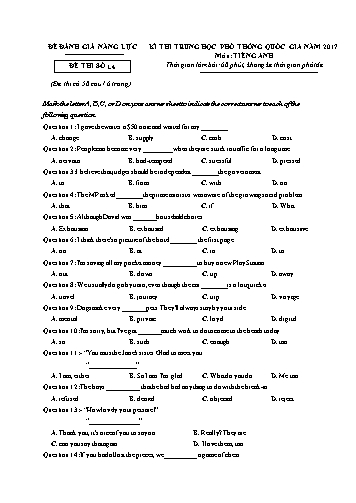
 ĐỀ ĐÁNH GIÁ NĂNG LỰC KÌ THI TRUNG HỌC PHỔ THÔNG QUỐC GIA NĂM 2017
 Môn: TIẾNG ANH
 ĐỀ THI SỐ 14 Thời gian làm bài: 60 phút, không kể thời gian phát đề
 (Đề thi có 50 câu / 6 trang)
Mark the letter A, B, C, or D on your answer sheet to indicate the correct answer to each of the
following question.
Question 1: I gave the waiter a $50 note and waited for my ________.
 A. changeB. supplyC. cashD. cost
Question 2: People can become very _________when they are stuck in traffic for a long time.
 A. nervousB. bad-temperedC. stressfulD. pressed
Question 3:1 believe that judges should be independent ________the government.
 A. toB. fromC. withD. on
Question 4: The MP asked ________the prime minister was aware of the growing social problem.
 A. thatB. himC. if D. What
Question 5: Although David was _______household chores.
 A. ExhaustionB. exhausted C. exhausting D. exhaustive
Question 6: I think there's a picture of the hotel ________ the first page.
 A. onB. at C. in D. to
Question 7: I'm saving all my pocket money __________ to buy a new PlayStation.
 A. outB. down C. up D. away
Question 8: We usually do go by train, even though the car ________is a lot quicker.
 A. travelB. journey C. trip D. voyage
Question 9: Dogs make very _______ pets. They'll always stay by your side.
 A. mentalB. privateC. loyal D. digital
Question 10: I'm sorry, but I've got _______much work to do to come to the beach today.
 A. so B. such C. enough D. too
Question 11: - “You must be Jane's sister. Glad to meet you.
 “______________”
 A. I am, either B. So I am. I'm glad C. What do you do D. Me too
Question 12: The boys __________ that he had had anything to do with the break-in.
 A. refused B. denied C. objected D. reject
Question 13: - “How lovely your pets are!”
 “_______________”
 A. Thank you, it's nice of you to say no B. Really? They are
 C. can you say that again D. I love them, too
Question 14: If you hadn't lost the pieces, we__________ a game of chess A. How the principles of use and disuse change people's concepts of themselves.
 B. The changes that occur according to the principle of use and disuse
 C. The way in which people change themselves to conform to fashion.
 D. The effects of the sun on the principle of use and disuse.
Question 19: The phrase "wither away" in bold is closest in meaning to
 A. splitB. rotC. perishD. shrink
Question 20: The word "Those" in bold refers to
 A. organismsB. bodiesC. partsD. muscles
Question 21: According to the passage, men who body build.
 A. appear like sculpturesB. change their appearance
 C. belong to strange cultsD. are very fashionable
Question 22: From the passage, it can be inferred that author views body building.
 A. with enthusiasmB. as an artistic from
 C. with scientific interest D. of doubtful benefic
Question 23: It can be inferred from the passage that the principle of use and dissure enables
organisms to
 A. change their existenceB. automatically benefit
 C. survive in any conditionD. improve their lifetime
Question 24: The author suggests that melanin
 A. is necessary for the production of vitamin-DB. is beneficial in sunless climates
 C. helps protect fair-skinned peopleD. is a synthetic product
Question 25: In the second paragraph, the author mentions suntanning as an example of
 A. humans improving their local conditionB. humans surviving in adverse conditions
 C. humans using the priciple of use and disuseD. humans running the risk of skin cancer
Mark the letter A, B, C, or D on your answer sheet to indicate the word whose underlined part that
differs from the other three in the pronunciation in each of the following questions.
Question 26: A. close-knitB. cactus. C. desertD. rhinoceros
Question 27: A. blamed B. dissolved C. misused D. increased
Mark the letter A, B, C, or D on your answer sheet to indicate the word that differs from the rest in
the position of the main stress in each of the following question.
Question 28: A. furnish B. reason C. promise D. tonight B. reason C. promise D. tonightm tj
Question 29: A. habitableB.infamously C. geneticistD. communist
Read the following passage and mark the letter A, B, C or D on your answer sheet to indicate the
correct word for each of the blanks.
 THE HISTORY OF WRITING
The development of writing (30) ________ a huge difference to the world and might see it as the
beginning of the media. Pieces of pottery with marks on that are probably numbers have been that had occurred all through the Western world since the time of the Industrial Revolution.
 Although the growth in Canada’s population had slowed down by 1966 (the increase in the
first half of the 1960s was only nine percent) another large population wave was coming over the
horizon. It would be composed of the children who were born during the period of the high birth rate
prior to 1957.
Question 35. What does the passage mainly discuss?
 A. Educational changes in Canadian societyB. Canada during the Second World War
 C. Population trends in postwar CanadaD. Standards of living in Canada
Question 36: The word “five” in bold refers to
 A. CanadiansB. yearsC. decadesD. marriages
Question 37: The word “surging” in bold is closest in meaning to
 A. new B. extra C. accelerating D. surprising
Question 38: The author suggests that in Canada during the 1950's
 A. the urban population decreased rapidlyB. fewer people married
 C. economic conditions were poorD. the birth rate was very high
Question 39: The author mention all of the following as causes of declines in population growth after
1957 EXCEPT
 A. people being better educatedB. people getting married earlier
 C. better standards of living D. couples buying houses
Question 40: It can be inferred from the passage that before the Industrial Revolution
 A. families were larger B. population statistics were unreliable
 C. the population grew steadilyD. economic conditions were bad
Question 41: The word “it” in bold refers to
 A. horizonB. population wave C. nine percentD. first half
Choose A, B, C, or D to indicate the word or phrase that is CLOSEST in meaning to the underlined
part in each of the following sentences.
Question 42: A nuclear station may take risk going off due to unexpected incidents.
 A. demolishingB. runningC. developingD. exploding
Question 43: The members of the orchestra have arrived an hour prior to the performance for a short
rehearsal.
 A. afterB. whileC. whenĐ. before
Mark the letter A, B, C, or D on your answer sheet to indicate the word or phrase that is
OPPOSITE in meaning to the underlined part in each of the following questions.
Question 44: Their writings were celebratory in nature, and they were uncritical in their selection
and use of sources.
 A. related to partiesB. religiousC. seriousD. disregard
Question 45: There are three crucial points in his argument. ĐÁP ÁN VÀ GIẢI THÍCH CHI TIẾT
 1A 2B 3B 4C 5B 6A 7C 8B 9C 10D
 11D 12B I3A 14D 15A 16B 17C Ỉ8B 19D 20D
 21B 22D 23C 24C 25C 26C 27D 28D 29C 30C
 31B 32A 33A 34A 35C 36A 37C 38D 39B 40A
 41B 42D 43D 44D 45A 46A 47D 48B 49D 50D
 GIẢI THÍCH CHI TIẾT
Question 1: Chọn A
Tạm dịch: Tôi đưa cho anh phục vụ một tờ 50 đô la và chờ tiền thừa trả lại.
Chú ý note ở đây không phải là ghi chú hay ghi chú mà là tờ tiền giẫy.
❖ Change (n) (đổi tiền)
❖ Supply (n) (cung cấp)
❖ Cash (n) (tiền mặt)
❖ Cost (n) (trị giá)
❖ Wait for my change: Đợi tiền trả lại.
Đáp án A là phù hợp nhất.
Question 2: Chọn B
Tạm dịch: Mọi người thường trở nên rẩt nóng tính khi họ bị tẳc đường lâu.
❖ Bad-tempered (nổi nóng, nóng tỉnh, cảu bẳn).
❖ Stressful (xì trét, áp lực)
❖ Nervous (sợ hãi, lo lẳng, bồn chồn)
❖ Pressed (áp lực, bị đè nặng)
Question 3: Chọn B
Tạm dịch: Tôi nghĩ rằng quan tòa nên tách biệt với chính phủ.
❖ Independent: độc lập khỏi/ tách ra khỏi đi với giới từ from: độc lập, tách biệt khôi ai/cái gì
Question 4: Chọn C
Tạm dịch: Vị nghị sỹ hỏi thủ tướng có biết được những vấn đề xã hội đang gia tăng không
Đây là dạng bài chuyển từ câu trực tiếp sang gián tiếp dạng câu nghi vấn. Câu gốc hỏi thù tướng có
biết hay không là loại Yes/No question, khi chuyển sang gián tiếp có cấu trúc như sau:
S + asked/wanted to know if/whether...
Vậy đáp án C là phù hợp nhất.
Question 5: Chọn B
❖ Exhaustion: sự kiệt sức ❖ What do you do: Câu hỏi nghề nghiệp. Dùng đáp trả trong trường hợp này là không lịch sự.
Question 12: Chọn B
Tạm dịch: Những chàng trai phủ nhận rằng anh ấy có bất kỳ cái gì để tấn công vào ngân hàng.
❖ Denied + V-ỉng hoặc denied + that + mệnh đê: phủ nhận không làm gi ,
❖ Refused + to V: từ chối, khước từ, cự tuyệt làm gì
❖ Reject + N: loại ra, bỏ ra; đánh hỏng'
❖ Object + to + V-ing: phản đổi, chống, chống đối
Để phù hợp ngữ nghĩa và cấu trúc thi dáp án B là hợp lý nhất.
Question 13: Chọn A
Thank you, It’s nicc of you to say so: là lời phúc đáp thích hợp nhất cho câu cảm thán phía trên
Lưu ý: Một số cấu trúc khen ngợi và đáp lại lời khen trong tiếng Anh:
Khen ngợi về diện mạo
Người Anh thường đưa ra lời khen về diện mạo của một ai đó như là màu mắt, kiểu tóc, vóc dáng,
hoặc ngoại hình chung. Tuy nhiên, bạn nên tránh đưa ra lời khen về những bộ phận cụ thể trên cơ thể
của họ vi điều đó sẽ làm họ cảm thấy khó chịu. Sự thân mật, gần gũi của bạn và người đó càng nhiều
thì bạn càng có thể đưa ra những lời khen về những vẩn đề riêng tư, cụ thê.
Ví dụ:
Robert: you really have beautiful eyes, Barbara. I’ve never seen such a gorgeous shade of blue:
Barbara, đôi mắt của em thực sự rất đẹp. Anh chưa bao giờ thấy đôi mắt màu xanh nào đẹp lộng lấy
như thế cả.
 - Barbara: Thank you, Robert. That’s a nice compliment: cám ơn anh, Robert. Đó là một lời
 khen rất hay.
Abdulla: Goodness, you look great, Beverly! Have you lost weight? ; Lạy chúa, trông em tuyệt quá,
Beverly! Em đã giảm cân phải không?
 - Beverly; That’s nice of you to notice. I’ve lost about 10 pounds, but I still need to lose another
 5 or 6: Rất vui là anh đã chú ý tới điều đó. Em đã giảm được 10 pounds rồi, nhưng em cần giảm
 thêm 5 hoặc 6 pounds nữa.
 - Gene: Your new hairstyle is terrific, Cindy!: kiểu tóc mới của em thật tuyệt, Cindy
 - Cindy: Thanks, Gene. I think I’ve finally found a style that looks decent and easy to handle:
 Cám ơn anh, Gene. Em nghĩ là cuối cùng em đã tìm được kiểu tóc phù hợp với mình.
Khen ngợi về kỹ năng hoặc sự thông minh.
Dưới đây là một số lời khen về khả năng hoặc sư thông minh mà người Anh hung thường dùng và cách đáp
lại những lời khen đó:
Pat: I didn’t know you could play the guitar so well Jone. Your song was lovely: Tớ không biết là cậu
lại có thể chơi ghi ta hay đến thể Jone ạ. Tiết mục của cậu rất tuyệt.
- Jone: thanks, pat. I’m glad you enjoy it: Cám ơn cậu, pat. Mình vui là cậu thích nó.
Yumi: Joe, your backhand (in tennis) is getting stronger every time we play!: Joe này, cú ve trái của
File đính kèm:
- de_danh_gia_nang_luc_ki_thi_trung_hoc_pho_thong_nam_2017_de.doc

