

Đề đánh giá năng lực - Kì thi trung học phổ thông năm 2017 - Đề thi số 15 (Có đáp án)
Mark the letter A, B, c, or D on your answer sheet to indicate the word or phrase that is OPPOSITE in meaning to the underlined part in each of the following questions.
Question 1: About 95 percent of all animals are invertebrates which can live anywhere, but most, like the starfish and crabs, live in the ocean.
A. with backbones B. with ribs c. without ribs D. without backbones
Question 2: He had never experienced such discourtesy towards the president as it occurred at the annual meeting in May.
A. politeness B. rudeness c. measurement D. encouragement
Mark the letter A, B, c, or D on your answer sheet to indicate the correct answer to each of the following questions.
Question 3: - "Mr. Adams is going to retire next month."
- “_____________.”
A. Oh, I have no idea C. Right, you’d probably be the next.
B. You don't say! D. Congratulations!
 18 trang
31/12/2025
860
18 trang
31/12/2025
860
Tóm tắt nội dung tài liệu: Đề đánh giá năng lực - Kì thi trung học phổ thông năm 2017 - Đề thi số 15 (Có đáp án)
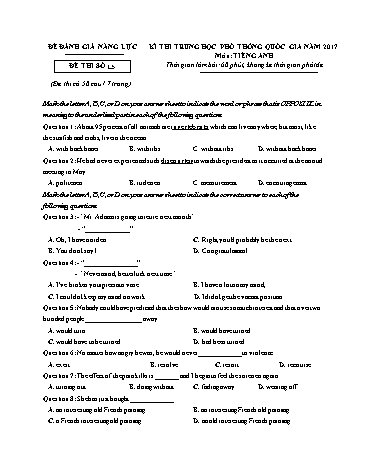
 ĐỀ ĐÁNH GIÁ NĂNG LỰC KÌ THI TRUNG HỌC PHỔ THÔNG QUỐC GIA NĂM 2017
 Môn: TIẾNG ANH
 ĐỀ THI SỐ 15 Thời gian làm bài: 60 phút, không kể thời gian phát đề
 (Đề thi có 50 câu / 7 trang)
Mark the letter A, B, C, or D on your answer sheet to indicate the word or phrase that is OPPOSITE in
meaning to the underlined part in each of the following questions.
Question 1: About 95 percent of all animals are invertebrates which can live anywhere, but most, like
the starfish and crabs, live in the ocean.
 A. with backbones B. with ribs C. without ribs D. without backbones
Question 2: He had never experienced such discourtesy towards the president as it occurred at the annual
meeting in May.
 A. politeness B. rudeness C. measurement D. encouragement
Mark the letter A, B, C, or D on your answer sheet to indicate the correct answer to each of the
following questions.
Question 3: - "Mr. Adams is going to retire next month."
 - “_____________.”
 A. Oh, I have no idea C. Right, you’d probably be the next.
 B. You don't say! D. Congratulations!
Question 4: - “________________”
 - "Never mind, better luck next time."
 A. I’ve broken your precious vase. B. I have a lot on my mind,
 C. I couldn’t keep my mind on work. D. I didn't get the vacant position.
Question 5: Nobody could have predicted that the show would arouse so much interest and that over two
hundred people _________________ away.
 A. would turn B. would have turned
 C. would have to be turned D. had been turned
Question 6: No matter how angry he was, he would never _____________ to violence.
 A. exert B. resolve C. resort D. recourse
Question 7: The effect of the painkiller is _______ and I begin to feel the soreness again.
 A. turning out B. doing without C. fading away D. wearing off
Question 8: She has just bought _____________.
 A. an interesting old French painting B. an interesting French old painting
 C. a French interesting old painting D. an old interesting French painting Question 20: A. touch B. watch C. machine D. armchair
Question 21: A. famous B. nervous C. loud D. serious
Mark the letter A, B, C, or D on your answer sheet to indicate the word that differs from the rest in the
position of the main stress in each of the following questions.
Question 22: A. zoology B. conquest C. cement D. duet
Question 23: A. photocopy B. particular C. enthusiasm D. economy
Mark the letter A, B, C or D on your answer sheet to indicate the word or phrase that is CLOSEST in
meaning to the underlined part in each of the following questions.
Question 24: At fifty-five, he began life again, determined with his pen to wipe out the debt.
 A. rub out B. pay off C. bump off D. give up
Question 25: The National Institute of Mental Health is conducting far-reaching research to determine
the psychological effects of using drugs.
 A. refined B. extensive C. prevalent D. tentative
Read the following passage and mark the letter A, B, C, or D on your answer sheet to indicate the
correct answer to each of the questions.
 Most forms of property are concrete and tangible, such as houses, cars, furniture or anything else that
is included in one’s possessions. Other forms of property can be intangible, and copyright deals with
intangible forms of property. Copyright is a legal protection extended to authors of creative works, for
example books magazine articles, maps, films, plays, television shows, software, paintings, photographs,
music, choreography in dance and all other forms of intellectual or artistic property.
 Although the purpose of artistic property is usually public use and enjoyment, copyright establishes
the ownership of the creator. When a person buys a copyrighted magazine, it belongs to this individual as
a tangible object. However, the authors of the magazine articles own the research and the writing that
went into creating the articles. The right to make and sell or give away copies of books or articles belongs
to the authors, publishers, or other individuals or organizations that hold the copyright. To copy an entire
book or a part of it, permission must be received from the copyright owner, who will most likely expect to
be paid.
 Copyright law distinguishes between different types of intellectual property. Music may be played by
anyone after it is published. However, if it is performed for profit, the performers need to pay a fee called
a royalty. A similar principle applies to performances of songs and plays. On the other hand, names, ideas
and book titles are excepted. Ideas do not become copyrighted property until they are published in a book
a painting or a musical work. Almost all artistic work created before the 20th century is not copyrighted
because it was created before the copyright law was passed.
 The two common ways of infringing upon the copyright are plagiarism and piracy. Plagiarizing the enforced
Read the following passage and mark the letter A, B, C, or D on your answer sheet to indicate the
correct answer to each of the questions.
 Cooperation is the common endeavor of two or more people to perform a task or reach a jointly
cherished goal. Like competition and conflict, there are different forms of cooperation, based on group
organization and attitudes.
 In the first form, known as primary cooperation, group and individual fuse. The group contains nearly
all of each individual’s life. The rewards of the group’s work are shared with each member. There is an
interlocking identity of individual, group and task performed. Means and goals become one, for
cooperation itself is valued.
 While primary cooperation is most often characteristic of preliterate societies, secondary cooperation
is characteristic of many modem societies. In secondary cooperation, individuals devote only part of their
lives to the group. Cooperation itself is not a value. Most members of the group feel loyalty, but the
welfare of the group is not the first consideration. Members perform tasks so that they can separately
enjoy the fruits of their cooperation in the form of salary prestige, or power. Business offices and
professional athletic teams are examples of secondary cooperation.
 In the third type called tertiary cooperation or accommodation, latent conflict underlies the shared
work. The attitudes of the cooperating parties are purely opportunistic: the organization is loose and
fragile. Accommodation involves common means to achieve antagonistic goals: it breaks down when the
common means cease to aid each party in reaching its goals. This is not, strictly speaking cooperation at
all, and hence the somewhat contradictory term antagonistic cooperation is sometimes used for this
relationship.
Question 34: What is the author’s main purpose in the first paragraph of to passage?
 A. To urge readers to cooperate more often
 B. To offer a brief definition of cooperation
 C. To explain how cooperation differs from competition and conflict
 D. To show the importance of group organization and attitudes
Question 35: The word cherished in paragraph 1 is closest in meaning to _______________
 A. defined B. agreed on C. prized D. set up
Question 36: Which of the following statements about primary cooperation is supported by information
in the passage?
 A. It is usually the first stage of cooperation achieved by a group of individuals attempting to cooperate
 B. It is most commonly seen among people who have not yet developed reading and writing skills
 C. It is an ideal that can never be achieved are convincing enough to find out through futher experiments precisely how the staring effect might
actually (45) ______________.
Question 41. A. shaded B. coveredC. masked D. wrapped
Question 42. A. worked over B. carried outC.carried on D. worked through
Question 43. A. parted B. seperatedC.split D. divided
Question 44. A. prevented B. omittedC. evaded D. ended
Question 45. A. set out B. be looked atC. come aboutD. be held up
Mark me later A, B, C, or D to indicate the sentence that best combines each pair of sentences in
the following questions.
Question 46: John is studying hard. He doesn’t want to fail the exam.
 A. John is studying hard in Oder not to fail the next exam
 B. John is studying hard in Oder that he not fail the next exam
 C. John is studying hard so as to fail the next exam
 D. John is studying hard in Oder to not to fail the next exam
Question 47: She gave in her notice. She planned to start her new job in January
 A. She gave in her notice, plan to start her new job in January
 B. She gave in her notice with a view to starting her new job in January
 C. Her notice was given in with an aim to start her new job in January
 D. Her notice was given in order for her to start her new job in January.
Mark the letter A, B, C or D on your answer sheet to indicate the sentence that is closest in meaning to
the sentence in italics.
Question 48: When the unemployment rate is high, the crime rate is usually also high.
 A. The unemployment rate and the crime rate are both higher.
 B. The higher the unemployment rate is, the higher the crime rate is.
 C. The unemployment rate is as high as the crime rate.
 D The high rate of unemployment depends on the high rate of crime.
Question 49: I wish you hadn't said that
 A. I wish you not to say that. B. If only you didn't say tot
 C. I hope you will not say that. D. It would be nice if you hadn’t said that.
Question 50: “You're always making terrible mistakes”, said the teacher.
 A. The teacher asked his students why they always made terrible mistakes.
 B. The teacher realized that his students always made terrible mistakes.
 C. The teacher complained about his students making terrible mistakes.
 D. The teacher made his students not always make terrible mistakes. chuyện phiền não quá ❖ To wear off: mất dần.
I couldn't keep my mind on work: Tôi không ❖ Turning out: trở nên
thề tập trung vào công việc được ❖ Doing without: bỏ qua
I didn't get the vacant position: Tôi đã không ❖ Fading away: giải tán
nhận được vị trí đang còn trống đó ” ❖ Question 8. Chọn A
“Vacant” ở đây không liên quan tới Tạm dịch: Cồ ẩy vừa mua một bức tranh cồ
“vacation”, không phải là “xuất đi nghi”, tránh thú vị của Pháp
nhầm lẫn “ vacant” và “ vacation”. “Vacant” Học sinh xem lại cách sắp xếp trật tự tính từ đã
(a): bị bỏ không, trống rỗng, không có người được đề cập ở các đề trước.
làm. Question 9. Chọn D
Question 5. Chọn C Tạm dịch: Tôi chưa bao giờ nghĩ một điều tồi
Tam dịch: Không ai có thể đoán trước được tệ như vậy lợi có thể xảy ra.'
chương trình lại có thể gây được nhiều thích It never entered my head that...! = I never
thú đến thế và rằng có tới hơn 200 người đã thought that Tôi chưa bao giờ nghĩ rằng, biết
không được cho vào. rằng.
To turn away: đuổi ra, bị từ chối không cho It never entered my head that....
làm gì, thải (người làm) Cấu trúc này đồng nghĩa với các dạng sau:
Question 6. Chọn C It never enters/ entered my mind that...
Tạm dịch: Cho dù anh ta có tức giận đến cỡ It never occurred to me that...
nào thì anh cũng chẳng bao giờ viện tới bạo It never crossed my mind that...
lực. Question 10. Chọn A
 Tạm dịch: Sarah và tôi ngẫu nhiên đặt một
❖ Resort to sth: phải động đến ai, viện đến,
 nhờ tới ai/cái gì. căn phòng trong cùng một khách sạn. Cô ấy đã
Các lựa chọn còn lại không phù hợp. rất ngạc nhiên khi nhìn thấy tôi ớ đó.
❖ Exsert on sb/sth: áp dụng cái gì. ❖ Coincidentally (một cách ngẫu nhiên).
❖ Resolve on /upon/against St / doing st: Các chọn lựa còn lại không phù hợp
kiên quyết. ❖ Practically (trên thực tế, thực tế ra)
❖ Have a recourse to sb / sth: nhờ cậy ai, cái ❖ Internationally (cố ý)
gì.
 ❖ Deliberately (chủ tâm)
Các lựa chọn còn lại không phù hợp.
 Question 11: Chọn C
Question 7. Chọn D
 Tạm dịch: Chúng tôi dành ra gần 3 tìểng đồng
Tạm dịch: Hiệu quả của thuốc giảm đau đang
 hồ chờ
mất dần và tôi bắt đầu cảm thấy cơn đau trở
 đợi bên ngoài trạm thì ngôi sao bước ra.
lại.
 Sử dụng đào ngữ nguyên động từ: Là hình thức
File đính kèm:
- de_danh_gia_nang_luc_ki_thi_trung_hoc_pho_thong_nam_2017_de.doc

