

Đề đánh giá năng lực - Kì thi trung học phổ thông năm 2017 - Đề thi số 2 (Có đáp án)
SECTION A (8 points):
Mark the letter A, B, C, or D on your answer sheet to indicate the word whose underlined part is pronounced differently from that of the rest in each of the following questions.
Question 1: A. chorus B. Christian C. cholesterol D. check
Question 2: A. enough B. rough C. tough D. though
Mark the letter A, B, C or D on your answer sheet to indicate the word that differs from the other three in the position of primary stress in each of the following questions.
Question 3: A. ordinary B. emphasis C. decompose D. calendar
Question 4: A. comfortable B. necessary C. community D. memorable
 19 trang
30/12/2025
800
19 trang
30/12/2025
800
Bạn đang xem tài liệu "Đề đánh giá năng lực - Kì thi trung học phổ thông năm 2017 - Đề thi số 2 (Có đáp án)", để tải tài liệu gốc về máy hãy click vào nút Download ở trên.
Tóm tắt nội dung tài liệu: Đề đánh giá năng lực - Kì thi trung học phổ thông năm 2017 - Đề thi số 2 (Có đáp án)
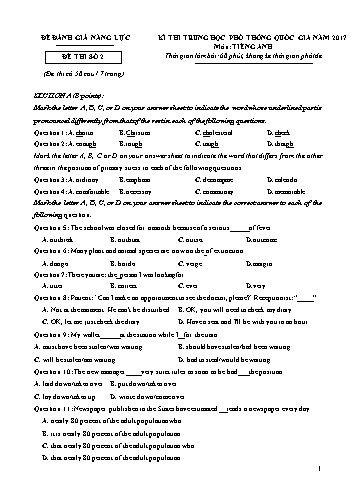
 ĐỀ ĐÁNH GIÁ NĂNG LỰC KÌ THI TRUNG HỌC PHỔ THÔNG QUỐC GIA NĂM 2017
 Môn: TIẾNG ANH
 ĐỀ THI SỐ 2 Thời gian làm bài: 60 phút, không kể thời gian phát đề
 (Đề thi có 50 câu / 7 trang)
SECTION A (8 points):
Mark the letter A, B, C, or D on your answer sheet to indicate the word whose underlined part is
pronounced differently from that of the rest in each of the following questions.
Question 1: A. chorus B. Christian C. cholesterol D. check
Question 2: A. enough B. rough C. tough D. though
Mark the letter A, B, C or D on your answer sheet to indicate the word that differs from the other
three in the position of primary stress in each of the following questions.
Question 3: A. ordinary B. emphasis C. decompose D. calendar
Question 4: A. comfortable B. necessary C. community D. memorable
Mark the letter A, B, C, or D on your answer sheet to indicate the correct answer to each of the
following question.
Question 5: The school was closed for a month because of a serious of fever.
 A. outbreak B. outburst C. outset D. outcome
Question 6: Many plant and animal species are now on the of extinction.
 A. danger B. border C. verge D. margin
Question 7: There you are: the person I was looking for.
 A. utter B. correct C. ever D. very
Question 8: Patient: "Can I make an appointment to see the doctor, please?" Receptionist: “ ”
 A. Not at the moment. He can't be disturbed. B. OK, you will need to check my diary.
 C. OK, let me just check the diary. D. Have a seat and I'll be with you in an hour.
Question 9: My wallet at the station while I for the train.
A. must have been stolen/was waiting B. should have stolen/had been waiting
C. will be stolen/am waiting D. had to steal/would be waiting
Question 10: The new manager very strict rules as soon as he had the position
A. laid down/taken over B. put down/taken over
C. lay down/taken up D. wrote down/come over
Question 11: Newspaper publishers in the States have estimated reads a newspaper every day.
 A. nearly 80 percent of the adult population who
 B. it is nearly 80 percent of the adult population
 C. that nearly 80 percent of the adult population who
 D. that nearly 80 percent of the adult population
 1 additives, especially colorings, and foods high in salicylates from their diets. A few of these are
almonds, green peppers, peaches, tea, grapes. This is the diet made popular by Benjamin Feingold,
who has written the book “Why your Child is Hyperactive”. Other researchers have had mixed
results when testing whether the diet is effective.
Question 19: The topic of this passage is
 A. reactions to foods B. food and nutrition C. infants and allergies D. a good diet
Question 20: According to the passage, the difficulty in diagnosing allergies to foods is due to
 A. the vast number of different foods we eat
 B. lack of a proper treatment plan
 C. the similarity of symptoms of the allergy to other problems
 D. the use of prepared formula to feed babies
Question 21: The phrase "set off" in lines 11 is closest in meaning to
 A. relieved B. identified C. avoided D. triggered
Question 22: What can be inferred about babies from this passage?
 A. They can eat almost anything.
 B. They should have a carefully restricted diet as infants.
 C. They gain little benefit from being breast fed.
 D. They may become hyperactive if fed solid food too early.
Question 23: The author states that the reason that infants need to avoid certain foods related to
allergies has to do with the infant's
 A. lack of teeth B. poor metabolism
 C. underdeveloped intestinal tract D. inability to swallow solid foods
Question 24: The word "these" in line 16 refers to
 A. food additives B. food colorings
 C. innutritious foods D. foods high in silicates
Question 25: Which of the following was a suggested treatment for migraines in the passage?
 A. Eating more ripe bananas B. Avoiding all Oriental foods
 C. Getting plenty of sodium nitrate D. Using Vitamin B in addition to a good diet
Question 26: According to the article the Feingold diet is NOT
A. verified by researchers as being consistently effective
B. available in book form
C. beneficial for hyperactive children
D. designed to eliminate foods containing certain food additives
Blacken the letter A, B, C, or D on your answer sheet to show the underlined part that needs
correction.
Question 27: Televisions are now an everyday feature of most households in the United States,
 3 Mark the letter A, B, C, or D on your answer sheet to indicate the word(s) OPPOSITE in meaning to the
underlined word(s) in each of the following questions.
Question 37: The government is encouraging everyone to save water by not washing their cars.
 A. conserve B. waste C. avoid D. collect
Question 38: Don’t tease her; she is fragile.
 A. strong B. breakable C. angry D. pissed off
Read the following passage and blacken the letter A, B, C or D on your answer sheet to indicate
the correct answer to each of the questions.
 Until recently, hunting for treasure from shipwrecks was mostly fantasy; with recent
technological advances, however, the search for sunken treasure has become more popular as a
legitimate endeavor. This has caused a debate between those wanting to salvage the wrecks and
those wanting to preserve them.
 Treasure hunters are spurred on by the thought of finding caches of gold coins or other
valuable objects on a sunken ship. One team of salvagers, for instance, searched the wreck of the
RMS Republic, which sank outside the Boston harbor in 1900. The search party, using side-scan
sonar, a device that projects sound waves across the ocean bottom and produces a profile of the sea
floor, located the wreck in just two and a half days. Before the use of this new technology, such
searches could take months or years. The team of divers searched the wreck for two months, finding
silver tea services, crystal dinnerware, and thousands of bottles of wine, but they did not find the
five and a half tons of American Gold Eagle coins they were searching for.
 Preservationists focus on the historic value of a ship. They say that even if a shipwreck's
treasure does not have a high monetary value, it can be an invaluable source of historic artifacts that
are preserved in nearly mint condition. But once a salvage team has scoured a site, much of the
archaeological value is lost. Maritime archaeologists who are preservationists worry that the success
of salvagers will attract more treasure-hunting expeditions and thus threaten remaining
undiscovered wrecks. Preservationists are lobbying their state lawmakers to legally restrict
underwater searches and unregulated salvages. To counter their efforts, treasure hunters argue that
without the lure of gold and million-dollar treasures, the wrecks and their historical artifacts would
never be recovered at all.
Question 39: What is the main idea of this passage?
 A. Searching for wrecks is much easier with new technologies like side-scan sonar.
 B. Maritime archaeologists are concerned about the unregulated searching of wrecks.
 C. The search of the RMS Republic failed to produce the hoped-for coins.
 D. The popularity of treasure seeking has spurred a debate between preservationists and salvagers.
Question 40: The word "sunken" in line 2 is closest in meaning to which of the following words?
 5 Mark the letter A, B, C, or D on you answer sheet to indicate the sentence that best combines
each pair of sentences in the following questions.
Question 49: John was not here yesterday. Perhaps he was ill.
 A. John needn't be here yesterday because he was ill.
 B. Because of his illness, John shouldn't have been here yesterday.
 C. John might have been ill yesterday, so he was not here.
 D. John must have been ill yesterday, so he was not here.
Question 50: "Cigarette?", he said. "No, thanks. ", I said.
 A. He asked for a cigarette, and I immediately refused.
 B. He mentioned a cigarette, so I thanked him.
 C. He offered me a cigarette, but I promptly declined.
 D. He asked if I was smoking, and I denied at once.
 7 Question 1: Chọn D ❖ Outbreak (Sự bùng phát)
❖ Chorus / 'kɔ: rəs / (v) (hợp xướng, đồng ca) ❖ Outburst (Sự bộc phát) (thường dùng nói về cảm
❖ Christian /'kristjən / (adj) (đạo Cơ đốc) xúc, tâm trạng giận dữ)
❖ Cholesterol / kəˈlɛstərɒl / (n) (chất béo gây xơ ❖ Outset (Sự bắt đầu, khởi đầu của việc gì đó)
cứng động mạch) Outcome (kết quả) (cuộc bầu cử, học tập, )
❖ Check / tʃek/ (v) (kiểm tra, kiểm soát) Question 6: Chọn C
Đáp án chính xác là đáp án D vì phần gạch chân đọc ❖ Ta có: on the verge of: trên bờ vực của.
là /tʃ/ khác với các từ còn lại đọc là /k/ Lưu ý:
Question 2: Chọn D ❖ In danger of: bị nạn, lâm vào cảnh nguy hiểm
❖ Enough /i'nʌf/ (adj) (đủ dùng) Eg: She is in danger of being complained because of
❖ Rough / rʌf/ (adj) (gồ ghề, dữ dội, thô lỗ) her mistakes
❖ Tough /tʌf / (adj) (dai, bền, cứng rắn, khó) ❖ By a margin of: với cách biệt là, tỉ số là
❖ Though / ðou/ (adv) (tuy nhiên, thế nhưng) Eg: She beat the other runner by a margin of 10
Đáp án chính xác là đáp án D vì phần gạch chân đọc seconds. Tạm dịch: Rất nhiều loài động thực vật
là âm câm khác với các từ còn lại đọc là /f/ đang trên bờ vực của sự tuyệt chủng.
Question 3: Chọn C nhấn trọng âm ở âm tiết thứ 3 Question 7: Chọn D
còn lại nhấn âm thứ 1 Ngoài nghĩa rất chỉ mức độ thì very còn có nghĩa là
❖ Ordinary (adj) (thông thường, bình thường). đích thị, đích thực dùng để nhấn mạnh
❖ Emphasis (n) (sự nhấn mạnh, tầm quan trọng, sự Eg: the very next day: ngay ngày hôm sau.
bối rối). Question 8: Chọn C
❖ Decompose (v) (phân tích, thối rữa) Đây là cuộc đối thoại giữa bệnh nhân và người tiếp
❖ Calendar (n) (lịch). khách ở phòng khám do đó ta có thể loại đáp án B và
Question 4: Chọn C nhấn trọng âm ở âm tiết thứ 2, D. Đáp án A không sai về mặt ý nghĩa tuy nhiên lời
còn lại nhấn âm thứ 1 nói không được lịch sự trong bối cảnh người đón tiếp
❖ Comfortable (adj) (thoải mái). nói chuyện với bệnh nhân Vậy đáp án chính xác là
❖ Necessary (adj) (cần thiết). đáp án C
❖ Community (n) (cộng đồng). Question 9: Chọn A
❖ Memorable (adj) (đáng ghi nhớ). Lưu ý đây là thức giả định dùng để diễn tả dự đoán
Question 5: Chọn A một sự việc:
Tạm dịch: Trường học bị đóng cửa trong một tháng ❖ Có khả năng xảy ra trong quá khứ ta dùng:
vì sự bùng phát dịch sốt nghiêm trọng. Must have + PII
 9
File đính kèm:
- de_danh_gia_nang_luc_ki_thi_trung_hoc_pho_thong_nam_2017_de.doc

