

Đề đánh giá năng lực - Kì thi trung học phổ thông năm 2017 - Đề thi số 6 (Có đáp án)
Read the following passage and mark the letter A, B, C or D on your answer sheet to indicate the correct answer to each of the following questions.
Question 1: “Remember to phone me when you arrive at the airport” “___________________”
A. I remember B. I do C. I don’t D. I will
Question 2: We should participate in the movements ________ the natural environment.
A. organizing to conserve B. organized conserving
C. organized to conserve D. which organize to conserve
Question 3: Certificates provide proof of your__________ .
A. qualifications B. diplomas C. ambitions D. in order that
 16 trang
30/12/2025
840
16 trang
30/12/2025
840
Bạn đang xem tài liệu "Đề đánh giá năng lực - Kì thi trung học phổ thông năm 2017 - Đề thi số 6 (Có đáp án)", để tải tài liệu gốc về máy hãy click vào nút Download ở trên.
Tóm tắt nội dung tài liệu: Đề đánh giá năng lực - Kì thi trung học phổ thông năm 2017 - Đề thi số 6 (Có đáp án)
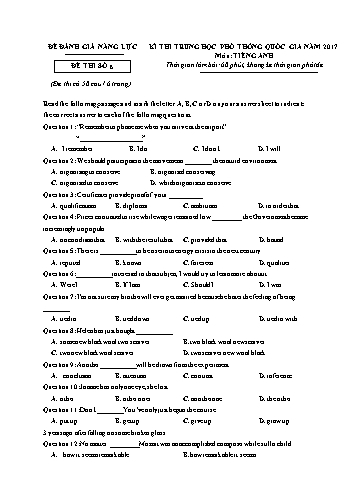
 ĐỀ ĐÁNH GIÁ NĂNG LỰC KÌ THI TRUNG HỌC PHỔ THÔNG QUỐC GIA NĂM 2017
 Môn: TIẾNG ANH
 ĐỀ THI SỐ 6 Thời gian làm bài: 60 phút, không kể thời gian phát đề
 (Đề thi có 50 câu / 6 trang)
Read the following passage and mark the letter A, B, C or D on your answer sheet to indicate
the correct answer to each of the following questions.
Question 1: “Remember to phone me when you arrive at the airport”
 “___________________”
 A. I remember B. I doC. I don’t D. I will
Question 2: We should participate in the movements ________ the natural environment.
 A. organizing to conserve B. organized conserving
 C. organized to conserveD. which organize to conserve
Question 3: Certificates provide proof of your __________.
 A. qualificationsB. diplomasC. ambitions D. in order that
Question 4: Prices continued to rise while wages remained low _________ the Government became
increasingly unpopular.
 A. on condition that B. with the result thatC. provided thatD. bound
Question 5: There is ___________to be a serious energy crisis in the next century.
 A. reputedB. knownC. foreseen D. qualities
Question 6:___________interested in that subject, I would try to learn more about it.
 A. Were IB. If I amC. Should ID. I was
Question 7: I’m not sure my brother will ever get married because he hates the feeling of being
________
 A. tied in B. tied downC. tied upD. tied in with
Question 8: Helen has just bought ___________.
 A. some new black wool two scarvesB. two black wool new scarves
 C. two new black wool scarvesD. two scarves new wool black
Question 9: Another ___________will be drawn from the experiment.
 A. conclusionB. attention C. contrast D. inference
Question 10: Joanne has only one eye, she lost
 A. otherB. other ones C. another one D. the other
Question 11: Don’t ________You’ve only just begun the course.
 A. put up B. get up C. give up D. grow up
3 years ago after falling on some broken glass.
Question 12: No matter _________Mozart was an accomplished composer while still a child.
 A. how it seems remarkable B. how remarkable it seems According to airline industry statistics, almost 90 percent of airline accidents are survivable or
partially survivable. But passengers can increase their chances of survival by learning and following
certain tips. Experts say that you should read and listen to safety instruction before take off and ask
questions if you have uncertainties. You should fasten your seat belt low on your hips and as tightly as
possible. Of course, you should also know how the release mechanism of your belt operates. During
takeoffs and landings, you are advised to keep your feet flat on the floor. Before take off, you should
locate the nearest exit and an alterative exit and count the rows of seats between you and the exits so
that you can reach them in the dark if necessary. In the event that you are forewarned of a possible
accident, you should put your hands on your ankles and keep your head down until the planes comes
to a complete stop. If smoke is present in the cabin, you should keep your head low and cover your
face with napkins, towels, or clothing. If possible, wet these for added protection against smoke
inhalation. To evacuate as quickly as possible, follow crew commands and do not take personal
belongings with you. Do not jump on escape slides before they are fully inflated, and when you jump,
do so with your arms and legs extended in front of you. When you get to the ground, you should move
away from the plane as quickly as possible, and smoke near the wreckage
Question 24: What is the main topic of the passage?
A. Procedures for evacuation aircraft.
B. Guidelines for increasing aircraft passenger survival,
C. Airline industry accident statistics.
D. Safety instructions in air travel.
Question 25: Travelers are urged by experts to read and listen to safety instruction _________.
A. if smoke is in the cabin B. in an emergency
C. before locating the exits D. before take-off
Question 26: According to the passage, airline travelers should keep their feet flat on the floor________.
 A. especially during landingsB. throughout the flight
 C. only if an accident is possible D. during take-offs and landings
Question 27: According to the passage, which exits should an airline passenger locate before take-
off?
 A. The ones with counted rows of seats between them. B. The nearest one.
 C. The two closest to the passenger’s seat D. The ones that can be found in the
 dark
Question 28: The word “them” in bold refers to
 A. seatsB. rowsC. exits D. feet
Question 29: It can be inferred from the passage that people are more likely to survive fires in
aircrafts if they
 A. don’t smoke in or near a planeB. read airline safety statistics
 C. wear a safety belt D. keep their heads low evolution this problem was solved by the lower eye “moving” around the other side. We see this
process of moving around enacted in the development of every young bony flatfish. It starts life
swimming near the surface, and is symmetrical and vertically flattened, but then the skull starts to
grow in a strange asymmetrical twisted fashion, so that one eye for instance the left, moves over the
top of the head upwards, an old Picasso - like vision. Incidentally, some species of 20 flatfish settle on
the right side, others on the left, and others on either side.
Question 37: The passage is mainly concerned with:
 A. symmetrical flatfish B. bony flatfish
 C. evolution of flatfishD. different types of flatfish
Question 38: The author mentions skates and rays as examples of fish that:
 A. become asymmetricalB. appear to fly
 C. have spread horizontallyD. resemble sharks
Question 39: It can be inferred from the passage that horizontal symmetrical fish:
 A. have one eye each side of the headB. have one eye underneath the head
 C. have two eyes on top of the headD. have eyes that move around the head
Question 40: The word “conversely” is closest in meaning to:
 A. SimilarlyB. AlternativelyC. InverselyD. Contrarily
Question 41: The word “this” refers to
 A. the migration of the ancestors
 B. the practice of lying on one side
 C. the problem of the one eye looking downwards
 D. the difficulty of the only one eye being useful
Question 42: According to the passage, the ability of a bony flatfish to move its eyes around is
 A. averageB. weak C. excellentD. variable
Question 43: It can be inferred from the passage that the early life of a flatfish is:
 A. often confusingB. pretty normalC. very difficultD. full of danger
Mark the letter A, B, C, or D on your answer sheet to indicate the word or phrase that is
OPPOSITE in meaning to the underlined part in each of the following questions.
Question 44: No one knew precisely what would happen to a human being in space
 A. casuallyB. flexiblyC. wronglyD. informally
Question 45: China has become the third country in the world which can independently carried out
the manned space activities.
 A. Put upB. put inC. put offD. put on
Mark the letter A, B, C, or D on you answer sheet to indicate the sentence that best combines each
pair of sentences in the following questions.
Question 46: It was an interesting novel. I stayed up all night to finish it
 A. I stayed up all night to finish the novel so it was interesting. ĐÁP ÁN VÀ GIẢI THÍCH CHI TIẾT
 1D 2A 3A 4B 5D 6A 7B 8C 9A 10D
 11C 12B 13B 14B 15A 16B 17B 18B 19A 20A
 21B 22A 23D 24B 25D 26D 27C 28C 29D 30D
 31A 32A 33C 34A 35D 36D 37C 38C 39C 40D
 41B 42C 43C 44C 45C 46D 47C 48A 49B 50D
 GIẢI THÍCH CHI TIẾT
Question 1: Chọn D Vậy nên: with the result that (cho nên) phù
Tạm dịch: "Nhớ gọi cho tôi khi bạn đến sân hợp với câu này.
bay nhé " - "Tôi sẽ gọi mà”. Các em lưu ý: Tất cả 4 cụm từ trên đều có
I will sử dụng ở đay như một lời hứa, lời đảm chức năng nối 2 mệnh đề với nhau.
bảo. Eg: - I'll come to the party on the condition
Question 2: Chọn C that you don't wear those ridiculous trousers!
Organize to do sth: tổ chúc, sắp xểp làm việc - He got married with her in order that he
gì đó could possess her villa.
Dễ thấy câu này viết đầy đủ phài là: “We Question 5: Chọn D
should participate in the movements which are ❖ To be bound to do St: Chơc chắn làm cái gì
organized to conserve the natural environment Tạm dịch: Chắc chắn sẽ có một cuộc khủng
→ ta sẽ lược bỏ “the movements which are hoảng năng lượng nghiêm trọng vào thể kỷ
organized to conserve” và thay bằng “the tiếp theo.
movements organized to conserve”. Question 6: Chọn A
Question 3: Chọn A Các em để ý, vế phải có “would try” nghĩ ngay
Tạm dịch: Giấy chứng nhận cung cấp bằng điều kiện loại 2. Đáp án A là dạng đảo ngữ của
chứng về trình độ cùa bạn. câu điều kiện loại II (to be chia thành were cho
 ❖ Your qualifications: chuyên môn, khả mọi ngôi).
 năng trình độ cùa bạn. Question 7: Chọn B
Question 4: Chọn B Tạm dịch: Tôi không chắc anh trai tôi sẽ kết
Tạm dịch: Giá cả tiếp tục tăng trong khi hôn vì anh ấy ghét cảm giác bị ràng buộc.
lương vẫn còn ở mức thấp cho nên chính phủ Với động từ tie. Có 2 cụm động từ cần lưu ý:
bắt đầu không được nhân dân ưa thích. ❖ Tie down: ràng buộc (đây là nội động từ
 ❖On condition that (với điều kiện), provided nên không có tân ngữ theo sau)
 that (với điểu kiện là, miễn là), in order that ❖ To be tied to st/sb: Bó buộc, ràng buộc vào
 (cot để, mục đích để) ai vài điều gì đó. (nhớ là không dùng to tie to ❖ Industry (n); công nghiệp Tạm dịch: Tuy nhiên gần đây cũng có vài tiến
❖ Industrialize (v): công nghiệp hóa triển
❖ Tạm dịch: Cô ẩy vô cùng tài năng và chăm ❖ However: tuy nhiên
chỉ. Question 20: Chọn A
Question 14: Chọn B ❖ Method/ 'mәθәd / (n) (phương pháp, cách
Cách hỏi, ngỏ lời mượn, nhờ vả lịch sự: “Is it thức)
all right if + Clause? - Trả lời “Sure, go ahead” ❖ Father/ 'fa:ðә / (n) (người cha, người thầy)
Tạm dịch: Tôi sử dụng xe đạp của bạn chắc ❖ Feather/ ´feðә / (n) (lông vũ, lông, bộ
không vấn đề gì chứ? — Chắc chắc rói, cứ lông, bộ cánh)
dùng đi. ❖ Weather/ 'weθә/ (n) (thời tiết, tiết trời)
Question 15: Chọn A . Đáp án chính xác là A vì phần gạch chân được
Tạm dịch: Nếu những công việc nhà máy đọc là âm /θ/ khác với những đáp án còn lại
nhàm chán và lập lại có thể được thực hiện đọc âm /ð/.
bởi robot thì tại sao những việc vặt nhàm chán Question 21: Chọn B
và lặp lại quanh nhà lại không thể cũng được ❖ Chemistry/ 'kemistri / (n) (ngành hoá học;
như vậy? môn hoả học, hoá học)
❖ To manage the factory work (the work be ❖ Children/ tʃìldrәn / (n) (lũ trẻ, bọn trẻ)
managed by): Đảm nhiệm, thực hiện công việc ❖ Schooling / 'sku:liɳ / (n) (sự dạy dỗ ở nhà
nhà máy trường, sự giáo dục ở nhà trường)
Question 16: Chọn B ❖ Character/ 'k„riktә / (n) (tính nết, tính
Tạm dịch: Một con robot thực hiện một phần cách; cá tính, đặc tính, đặc điểm; nét đặc sắc)
việc Đáp án chính xác là B vì phần gạch chân được
❖ Carry out: tiến hành, thực hiện (A factory đọc là âm /tʃ/ khác với những đáp án còn lại
robot carried out one task) đọc âm /k/.
Question 17: Chọn B Question 22: Chọn A
Tạm dịch: Một con robot làm việc nhà, một Nhấn trọng âm ở âm tiết thứ 2, còn lại nhấn
khác, phải thực hiện một vài loại lau chùi khác âm thứ 1
nhau... ❖ Political (adj) (chính trị)
❖ Several different types of: một vài loại ❖ Furniture (n) (đồ đạc, đồ nội thất)
khác nhau cùa... ❖ Yesterday (n) (ngày hôm qua)
Question 18: Chọn 6 ❖ Ambulance (n) (xe círu (hương)
Tạm dịch: ... và ỉàtìì các công việc và cũng Question 23: Chọn D
phải đuxmg đâu với tút củ các một bằng và vị Nhấn trọng âm ở âm tiết thứ 2, còn lại nhấn
trí khác nhau của các cân plĩỏng, đồ nội thất, âm thứ 1
trang trí, chó, mèo. ❖ Humorous (adj) (khôi hài, hài hước; hóm
❖ To cope with: đối phó, đương đầu với hình)
Question 19: Chọn A
File đính kèm:
- de_danh_gia_nang_luc_ki_thi_trung_hoc_pho_thong_nam_2017_de.doc

