

Đề đánh giá năng lực - Kì thi trung học phổ thông năm 2017 - Đề thi số 8 (Có đáp án)
Mark the letter A, B, C, or D on your answer sheet to indicate the correct answer to each of the following questions.
Question 1: Last year she earned _______ her brother.
A. twice as much as B. twice more than C. twice as many as D. twice as more as
Question 2: The politician tried to arouse the crowd, but most of them were ________ to his arguments.
A. closed B. indifferent C. careless D. dead
Question 3: - Can you take the day off tomorrow?
- Well, I’ll have to get _________ from my boss.
A. permission B. licence C. allowance D. permit
 18 trang
30/12/2025
670
18 trang
30/12/2025
670
Bạn đang xem tài liệu "Đề đánh giá năng lực - Kì thi trung học phổ thông năm 2017 - Đề thi số 8 (Có đáp án)", để tải tài liệu gốc về máy hãy click vào nút Download ở trên.
Tóm tắt nội dung tài liệu: Đề đánh giá năng lực - Kì thi trung học phổ thông năm 2017 - Đề thi số 8 (Có đáp án)
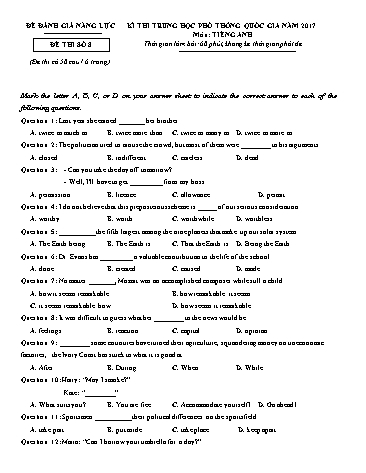
 ĐỀ ĐÁNH GIÁ NĂNG LỰC KÌ THI TRUNG HỌC PHỔ THÔNG QUỐC GIA NĂM 2017
 Môn: TIẾNG ANH
 ĐỀ THI SỐ 8 Thời gian làm bài: 60 phút, không kể thời gian phát đề
 (Đề thi có 50 câu / 6 trang)
Mark the letter A, B, C, or D on your answer sheet to indicate the correct answer to each of the
following questions.
Question 1: Last year she earned _______ her brother.
 A. twice as much as B. twice more than C. twice as many as D. twice as more as
Question 2: The politician tried to arouse the crowd, but most of them were ________ to his arguments.
 A. closed B. indifferent C. careless D. dead
Question 3: - Can you take the day off tomorrow?
 - Well, I’ll have to get _________ from my boss.
 A. permission B. licence C. allowance D. permit
Question 4: I do not believe that this preposterous scheme is _____ of our serious consideration.
 A. worthy B. worth C. worthwhile D. worthless
Question 5: __________ the fifth largest among the nine planets that make up our solar system.
 A. The Earth being B. The Earth is C. That the Earth is D. Being the Earth
Question 6: Dr. Evans has _________ a valuable contribution to the life of the school.
 A. done B. created C. caused D. made
Question 7: No matter _______, Mozart was an accomplished composer while still a child.
 A. how it seems remarkable B. how remarkable it seems
 C. it seems remarkable how D. how seems it remarkable
Question 8: It was difficult to guess what her ________ to the news would be.
 A. feelings B. reaction C. capital D. opinion
Question 9: ________ some countries have ruined their agriculture, squandering money on uneconomic
factories, the Ivory Coast has stuck to what it is good at.
 A. After B. During C. When D. While
Question 10: Harry: “May I smoke?”
 Kate: “________”
 A. What suits you? B. You are free C. Accommodate yourself! D. Go ahead!
Question 11: Sportsmen __________ their political differences on the sports field.
 A. take part B. put aside C. take place D. keep apart
Question 12: Maria: “Can I borrow your umbrella for a day?” A B C D
Question 24: The children had such difficult time when they began school in their new neighbourhood that
 A B
their parents decided never to move again.
 C D
Question 25: The lion has long been a symbol of strength, power, and it is very cruel.
 A B C D
Read the following passage and mark the letter A, B, C, or D on your answer sheet to indicate the correct
answer to each of the questions.
 Accustomed though we are to speaking of the films made before 1927 as "silent", the film has never
been, in the full sense of the word, silent. From the very beginning, music was regarded as an
indispensable accompaniment; when the Lumiere films were shown at the first public film exhibition in
the United States in February 1896, they were accompanied by piano improvisations on popular tunes. At
first, the music played bore no special relationship to the films; an accompaniment of any kind was
sufficient. Within a very short time, however, the incongruity of playing lively music to a solemn film
became apparent, and film pianists began to take some care in matching their pieces to the mood of the film.
 As movie theaters grew in number and importance, a violinist, and perhaps a cellist, would be added to
the pianist in certain cases, and in the larger movie theaters small orchestras were formed. For a number of
years the selection of music for each film program rested entirely in the hands of the conductor or leader of the
orchestra, and very often the principal qualification for holding such a position was not skill or taste so much as
the ownership of a large personal library of musical pieces. Since the conductor seldom saw the films until the
night before they were to be shown (if, indeed, the conductor was lucky enough to see them then), the musical
arrangement was normally improvised in the greatest hurry.
 To help meet this difficulty, film distributing companies started the practice of publishing suggestions
for musical accompaniments. In 1909, for example, the Edison Company began issuing with their films
such indications of mood as "pleasant', "sad", "lively". The suggestions became more explicit, and so
em erged the musical cue sheet containing indications of mood, the titles of suitable pieces of music, and
precise directions to show where one piece led into the next.
 Certain films had music especially composed for them. The most famous of these early special scores
was that composed and arranged for D. W. Griffith's film Birth of a Nation, which was released in 1915.
Question 26: The passage mainly discusses music that was ____________.
 A. performed before the showing of a film B. played during silent films
 C. recorded during film exhibitions D.specifically composed for certain movie theaters
Question 27: What can be inferred that the passage about the majority of films made after 1927? Research in Finland recently found overwhelming evidence that neighbours have a big influence on
buying decisions. When one of a person’s ten nearest neighbours bought a car, the chances that that person
would buy a car of the same brand during the next week and a half (38) __________ by 86 per cent. The
researchers argued that it was not just a matter of envy. Used cars seemed to attract neighbours even more than
new cars. This suggested that people were not trying to keep up with their neighbours, they were keen to learn
from them. Since used cars are less reliable, a recommendation of one can strongly influence a buying decision.
Question 34: A. What’s more B. Instead C. Unlike D. In place
Question 35: A. basing B. trusting C. supposing D. relying
Question 36: A. connection B. regard C. relation D. concern
Question 37: A. for B. as to C. out of D. about
Question 38: A. boosted B. rose C. enlarged D. lifted
Read the following passage and mark the letter A, B, C, or D on your answer sheet to indicate the
correct answer to each of the questions.
 Glass is a remarkable substance made from the simplest raw materials. It can be colored or
colorless, monochrome or polychrome, transparent, translucent, or opaque. It is lightweight impermeable to
liquids, readily cleaned and reused, durable yet fragile, and often very beautiful. Glass can be decorated in
multiple ways and its optical properties are exceptional. In all its myriad forms - as table ware, containers, in
architecture and design -glass represents a major achievement in the history of technological developments.
 Since the Bronze Age about 3, 000 B. C. glass has been used for making various kinds of objects. It
was first made from a mixture of silica, line and an alkali such as soda or potash, and these remained
the basic ingredients of glass until the development of lead glass in the seventeenth century. When
heated, the mixture becomes soft and malleable and can be formed by various techniques into a vast array of
shapes and sizes. The homogeneous mass thus formed by melting then cools to create glass, but in contrast to
most materials formed in this way (metals, for instance), glass lacks the crystalline structure normally
associated with solids, and instead retains the random molecular structure of a liquid. In effect, as molten
glass cools, it progressively stiffen s until rigid, but does so without setting up a network of interlocking crystals
customarily associated with that process. This is why glass shatters so easily when dealt a blow. Why glass
deteriorates over time, especially when exposed to moisture, and why glassware must be slowly reheated and
uniformly cooled after manufacture to release internal stresses induced by uneven cooling.
 Another unusual feature of glass is the manner in which its viscosity changes as it turns from
a cold substance into a hot, ductile liquid. Unlike metals that flow or freeze at specific temperatures glass
progressively softens as the temperature rises, going through varying stages of malleability until it flows like a
thick syrup. Each stage of malleability allows the glass to be manipulated into various forms, by different A. If they got unbiased information, they could know the true story.
 B. If they had unbiased the information, they could have known the true story.
 C. If they had been exposed to unbiased information, they would have known the true story.
 D. If they have exposed to the unbiased information, they could have seen the true story.
Question 48: It doesn't cost much to run a solar power system.
 A. A solar power system is quite cheap to set up. B. Running a solar power system costs nothing.
 C. A solar power system costs so much to run. D. Running a solar power system is not costly.
Mark the letter A, B, C, or D on you answer sheet to indicate the sentence that best combines each pair of
sentences in the following questions.
Question 49: He is very intelligent. He can solve all the problems in no time.
 A. So intelligent is he that he can solve all the problems in no time.
 B. He is very intelligent that he can solve all the problems in no time.
 C. An intelligent student is he that he can solve all the problems in no time.
 D. So intelligent a student is he that he can solve all the problems in no time.
Question 50: We cut down many forests. The Earth becomes hot.
 A. The more forests we cut down, the hotter the Earth becomes.
 B. The more we cut down forests, the hotter the Earth becomes.
 C. The more forests we cut down, the Earth becomes hotter.
 D. The more we cut down forests, the Earth becomes hotter. ❖ Worthless là tính từ ĐỒNG NGHĨA VỚI Tạm dịch: Trong khi một vài quốc gia tàn phá nền
 VALUELESS: KHÔNG CÓ GIÁ TRỊ và TRÁI nông nghiệp, đổ tiền vào những nhà máy gây lãng phí
 NGHĨA VỚI VALUABLE/PRICELESS thì Ivory Coast lại tận dụng những thế mạnh của họ.
 Question 5: Chọn B Question 10: Chọn D
 Đây là câu thử độ phân tích thành phần câu. Ta Câu cảm thán Go ahead!: Cứ tự nhiên.
 thấy rằng câu này có 1 mệnh đề quan hệ với đại từ Tạm dịch: Tôi có thể hút thuốc không?- Cứ tự nhiên
 THAT bổ nghĩa cho planets, nhưng mệnh đề đi
 chính (mệnh đề trước that) lại thiếu động từ chính Question 11: Chọn B
 nên chọn câu B có động từ chính là is. Vì đây là 1 ❖ Put aside: gạt sang một bên.
 câu đơn bình thường. Các đáp án khác không phù hợp.
 Tạm dịch: Trái đất lớn thứ 5 trong số 9 hành ❖ Take part in: tham gia
 tinh trong hệ mặt trời. ❖ Take place: thế chỗ
 Question 6: Chọn D Tạm dịch: Các vận động viên gạt sự khác biệt chính
 Cách diễn đạt: To make a contribution to trị sang một bên khi thi đấu thể thao.
 something: góp phần Question 12: Chọn A
 Question 7: Chọn B ❖ With pleasure: Chỉ sự đồng ý một cách lịch sự.
 Các bạn nhớ cách diễn đạt: Tạm dịch: Mình có thể mượn ô của bạn một ngày
 No matter + how + adj/adv +S + V: Dù cho có như được không? – Được thôi!
 thế nào đi chăng nữa. Question 13: Chọn A
 Tạm dịch: Bạn có thể mượn bao nhiêu sách cũng Câu ghép thông thường với “when”. Tất cả đã xảy ra
 được miễn là bạn phải trình chúng tới bất kì ai ở trong quá khứ, là một câu kể, ta chọn thì quá khứ đơn.
 bàn. Tạm dịch: Khi cô ấy đã nhận lỗi của cô ấy thì cô ấy
 Question 8: Chọn B xin lỗi.
 ❖ Reaction to st: sự phản ứng đối với cái gì Question 14: Chọn B
 ❖ Opinion about/on st = feeling about st: quan Loại A vì At best: mang nghĩa là ý kiến tốt nhất,
 điểm về việc gì trong điều kiện tốt nhất
 Question 9: Chọn D Loại C vì phải là what the best
 Đây là dạng câu ta phải dịch nghĩa để thấy sự đối lập Loại D vì có đến 2 động từ chính trong 1 câu
 về Tạm dịch: Mình có thể mượn ô của bạn một ngày
 nghĩa của 2 vế. được không? – Được thôi!
 ❖ While: Khi mà, trong khi. Question 15: Chọn A
 Eg: I thought I heard him come in while we were Tạm dịch: Vào năm 1864, George Pullman đã thiết
 having dinner: Tôi nghĩ là tôi đã nghe thấy tiếng anh kế một chiếc xe có giường ngủ đã được sử dụng
 ta rộng rãi.
 vào trong khi chúng tôi đang dùng bữa tối. ❖ Eventually (adv) (cuối cùng)
File đính kèm:
- de_danh_gia_nang_luc_ki_thi_trung_hoc_pho_thong_nam_2017_de.doc

