

Đề đánh giá năng lực - Kì thi trung học phổ thông năm 2017 - Đề thi số 9 (Có đáp án)
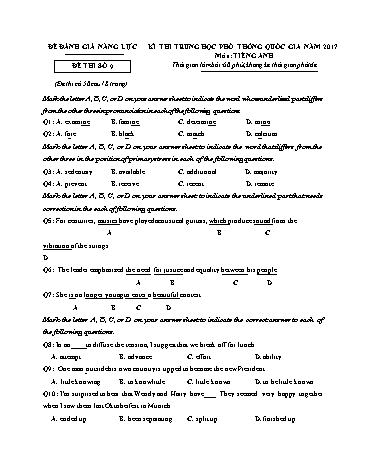
Mark the letter A, B, C, or D on your answer sheet to indicate the word whose underlined part differs from the other three in pronunciation in each of the following questions.
Q1: A. examine B. famine C. determine D. miner
Q2: A. fare B. black C. match D. calcium
Mark the letter A, B, C, or D on your answer sheet to indicate the word that differs from the other three in the position of primary stress in each of the following questions.
Q3: A. sedentary B. available C. additional D. majority
Q4: A. prevent B. receive C. recent D. remote
 16 trang
31/12/2025
810
16 trang
31/12/2025
810
Bạn đang xem tài liệu "Đề đánh giá năng lực - Kì thi trung học phổ thông năm 2017 - Đề thi số 9 (Có đáp án)", để tải tài liệu gốc về máy hãy click vào nút Download ở trên.
Tóm tắt nội dung tài liệu: Đề đánh giá năng lực - Kì thi trung học phổ thông năm 2017 - Đề thi số 9 (Có đáp án)
 ĐỀ ĐÁNH GIÁ NĂNG LỰC KÌ THI TRUNG HỌC PHỔ THÔNG QUỐC GIA NĂM 2017
 Môn: TIẾNG ANH
 ĐỀ THI SỐ 9 Thời gian làm bài: 60 phút, không kể thời gian phát đề
 (Đề thi có 50 câu / 8 trang)
Mark the letter A, B, C, or D on your answer sheet to indicate the word whose underlined part differs
from the other three in pronunciation in each of the following questions.
Q1: A. examineB. famineC. determineD. miner
Q2: A. fareB. blackC. matchD. calcium
Mark the letter A, B, C, or D on your answer sheet to indicate the word that differs from the
other three in the position of primary stress in each of the following questions.
Q3: A. sedentaryB. availableC. additional D. majority
Q4: A. preventB. receiveC. recentD. remote
Mark the letter A, B, C, or D on your answer sheet to indicate the underlined part that needs
correction in the each of following questions.
Q5: For centuries, musics have played acoustical guitars, which produce sound from the
 A B C
vibration of the strings.
D
Q6: The leader emphasized the need for justice and equality between his people.
 A B C D
Q7: She is no longer young to enter a beautiful contest.
 A B C D
Mark the letter A, B, C, or D on your answer sheet to indicate the correct answer to each of
the following questions.
Q8: In an to diffuse the tension, I suggest that we break off for lunch.
 A. attemptB. advanceC. effortD. ability
Q9: One man outside his own country is tipped to become the new President.
 A. little knowingB. to know littleC. little knownD. to be little known
Q10: I’m surprised to hear that Wendy and Harry have . They seemed very happy together
when I saw them last Oktoberfest in Munich.
 A. ended upB. been separatingC. split upD. finished up B. I have a lot on my mind
 C. I couldn’t keep my mind off work
 D. I didn’t get the vacant position
Mark the letter A, B, C, or D on your answer sheet to indicate the word(s) CLOSEST in
meaning to the underlined word(s) in each of the following questions.
Q22: When being interviewed, concentrate on what the interviewer is saying or asking you.
 A. pay all attention to
 B. be interested in
 C. be related to
 D. express interest to
Q23: We really appreciate your help, without which we couldn’t have got our task done in time.
 A. depreciateB. are proud ofC. feel thankful forD. require
Mark the letter A, B, C, or D on your answer sheet to indicate the word(s) OPPOSITE in
meaning to the underlined word(s) in each of the following questions.
Q24: “Don’t be such a pessimist. I’m sure you’ll soon get over it. Cheer up!”
 A. activistB. feministC. optimistD. hobbyist
Q25: Fruit and vegetables grew in abundance on the islanD. The islander even exported the
surplus.
 A. excessB. small quantityC. sufficiencyD. large quantity
Mark the letter A, B, C, or D on your answer sheet to indicate the sentence that is closest in
meaning to each of the following questions.
Q26: The demand was so great that they had to reprint the book immediately.
 A. So great was the demand that they had to reprint the book immediately.
 B. So great the demand was that they had to reprint the book immediately.
 C. So great was the demand so they had to reprint the book immediately.
 D. So great the demand was, they had to reprint the book immediately.
Q27: My friend said to me, “If I were you, I would tell them the truth.
 A. My friend said me to tell the truth.
 B. My friend advised me to tell the truth. they were being stared at. In a total of 18.000 trials (34)worldwide, the children (35) sensed
when they were being watched almost 70% of the time.
Q31. A. triesB. attempts C. tests D. aims
Q32: A. genuineB. acceptedC. receivedD. sure
Q33: A. noticeB. find C. reveal D. tell
Q34: A. worked throughB. worked overC. carried onD. carried out
Q35. A. thoroughlyB. correctlyC. exactly D. perfectly
Read the following passage and mark the letter A, B, C, or D on your answer sheet to indicate
the correct answer to each of the questions from 36 to 42.
 The history of clinic nutrition, or the study of the relationship between health and how the
body takes in and utilizers food substances, can be divided into four distinct eras: the first began
in the nineteenth century and extended into the early twentieth century when it was recognized
for the first time that food contained constituents that were essential for human function and that
different foods provided different amounts of these essential agents. Near the end of this era,
research studies demonstrated that rapid weight loss was associated with nitrogen imbalance and
could only be rectified by providing adequate protein associate with certain foods.
 The second era was initiated in the early decades of the twentieth century and might be
called “the vitamin period”. Vitamins came to be recognized in foods, and deficiency syndromes
were described. As vitamins became recognized as essential food constituents necessary for
health, it became tempting to suggest that every disease and condition for which there had been
no previous effective treatment might be responsive to vitamin therapy. At the point in time,
medical schools started to become more interested in having their curricula integrate nutritional
therapies in medicine. Reckless claims were made for effects of vitamins that went far beyond
what could actually be achieved from the use of them.
 In the third era of nutritional history in the early 1950’s to midd1960’s, vitamin therapy
began to fall into disrepute. Concomitant with this, nutrition education in medical schools also
became less popular. It was just a decade before this that many drug companies had found their
vitamins sales skyrocketing and were quick to supply practicing physicians with generous
samples of vitamins and literature extolling the virtue of supplementation for a variety
healthdrelated conditions. Expectations as to the success of vitamins in disease control were
exaggerateD. As is known in retrospect, vitamin and mineral therapies are much less effective the correct answer to each of the questions from 43 to 50.
 Plants and animals will find it difficult to escape from or adjust to the effect of global
warming. Scientists have already observed shifts in the lifecycles of many plants and animals,
such as flowers blooming earlier and birds hatching earlier in the spring. Many species have
begun shifting where they live or their annual migration patterns due to warmer temperatures.
 With further warming, animals will tend to migrate toward the poles and up mountainsides
toward higher elevations. Plants will also attempt to shift their ranges, seeking new areas as old
habitats grow too warm. In many places, however, human development will prevent these shifts.
Species that find cities or farmland blocking their way north or south may become extinct.
Species living in unique ecosystems, such as those found in polar and mountaintop regions, are
especially at risk because migration to new habitats is not possible. For instance, polar bears and
marine mammals in the Arctic are already threatened by dwindling sea ice but have nowhere
farther to go.
 Projecting species extinction due to global warming is extremely difficult. Some scientists
have estimated that 20 to 50 percent of species could be committed to extinction with 2 to 3
Celsius degrees of further warming. The rate of warming, not just the magnitude, is extremely
important for plants and animals. Some species and even entire ecosystems, such as certain types
of forest, many not be able to adjust quickly enough and may disappear.
 Ocean ecosystems, especially fragile ones like coral reefs, will also be affected by global
warming. Warmer ocean temperatures can cause coral to “bleach”, a state which if prolonged
will lead to the death of the coral. Scientists estimate that even 1 Celsius degree of additional
warming could lead to widespread bleaching and death of coral reefs around the world. Also,
increasing carbon dioxide in the atmosphere enters the ocean and increases the acidity of ocean
waters. This acidification further stresses ocean ecosystems.
Q43: Scientists have observed that warmer temperatures in the spring cause flower to .
A. die instantlyB. bloom earlier C. become lighterD. lose colour
Q44: According to paragraph 2, when their habitats grow warmer, animals tend to move .
 A. south – eastwards and down mountainsides toward lower elevations.
 B. north – westwards and up mountainsides toward higher elevations.
 C. toward the North Pole and down mountainsides toward lower elevations. KEYS
 Q1: D Q11: D Q21: D Q31: B Q41: D
 Q2: A Q12: D Q22: A Q32: A Q42: C
 Q3: A Q13: B Q23: C Q33: D Q43: B
 Q4: C Q14: C Q24: C Q34: D Q44: D
 Q5: A Q15: C Q25: B Q35: B Q45: A
 Q6: C Q16: C Q26: A Q36: C Q46: C
 Q7: C Q17: B Q27: B Q37: A Q47: D
 Q8: A Q18: A Q28: C Q38: B Q48: A
 Q9: C Q19: C Q29: B Q39: B Q49: B
 Q10: C Q20: B Q30: B Q40: D Q50: D
GIẢI THÍCH CHI TIẾT
Mark the letter A, B, C, or D on your answer sheet to indicate the word whose underlined part
differs from the other three in pronunciation in each of the following questions.
Q1: Đáp án D. Phát âm là /aɪ/ Các đáp án khác phát âm là /ɪn/
Q2: Đáp án A. Phát âm là /eə/ Các đáp án khác phát âm là /æ/
Mark the letter A, B, C, or D on your answer sheet to indicate the word that differs from the
other three in the position of primary stress in each of the following questions.
Q3: A
 A. sedentary /ˈsedntri/ (a) : ngồi nhiều, tĩnh tại
 B. available /əˈveɪləbl/ (a): sẵn có
 C. additional /əˈdɪʃənl/ (a): thêm vào, công vào
 D. majority /məˈdʒɒrəti/ (n): phần lớn, đa số
Q4: C
 A. prevent /prɪˈvent/ (v): ngăn cản, ngăn ngừa
 B. receive /rɪ'si:v/ (v): tiếp nhận
 C. recent /'ri:snt/ (adj): gần đây, cách đây không lâu
 D. remote /rɪ'mout/ (adj): hẻo lánh, xa xôi
Mark the letter A, B, C, or D on your answer sheet to indicate the underlined part that needs
correction in each of the following questions.
Q5: A.
Động từ “ have played” chủ từ chỉ người số nhiều Cấu trúc so sánh hơn short adj+er quieter
Dịch: Chỗ này quá ồn ào. Chúng ta có thể tìm chỗ nào khác yên tĩnh hơn không?
Q14: C
advance to/towards sth: đạt đến mức độ nào, giai đoạn nào = reach/approach sth Dịch: Mario đã
đạt đức mức độ nói tiếng anh gần như trôi chảy rồi.
Q15: C
resort TO sth: sử dụng đến cái gì (tiêu cực) exert sth: sử dụng sth
resolve ON sth/V_ing: kiên quyết làm gì have a recourse TO sb/sth: nhờ cậy ai, cái gì
Dịch: Dù giận dữ đến đâu, anh ấy cũng không bao giờ sử dụng bạo lực.
Q16: C
weigh up the pros and cons: cân nhắc ưu, nhược điểm turn over a new leaf: bước sang trang mới
Dịch: Khi làm việc gì, bạn cũng phải cân nhắc ưu, nhược điểm.
Q17: B
every so often = now and then = once in a while = sometimes: thỉnh thoảng
Dịch: Thỉnh thoảng tôi thích làm việc gì đó thật ngẫu hứng.
Q18: A
to butt in = come between: xen vào, chen ngang vào
Dịch: Này, bạn có thể dừng việc chen ngang vào và để tôi nói xong câu được không?
Q19: C
coverage: việc đưa tin
coverage of sporting events: sự kiện thể thao
Dịch: Cả 3 kênh truyền hình đều cung cấp một lượng lớn các chương trình sự kiện thể thao.
Mark the letter A, B, C, or D on your answer sheet to indicate the most suitable response to
complete each of the following exchanges.
Q20: B
Dùng “Many thanks!” để đáp lại lời khen Q21: D
Dịch: “Tôi đã không dành được vị trí trống đó (việc làm).” – “Không sao, lần tới sẽ may mắn
hơn.”
Mark the letter A, B, C, or D on your answer sheet to indicate the word(s) CLOSEST in
meaning to the underlined word(s) in each of the following questions.
Q22: A
File đính kèm:
- de_danh_gia_nang_luc_ki_thi_trung_hoc_pho_thong_nam_2017_de.doc

