

Đề thi minh họa - Kỳ thi THPT quốc gia năm 2015 môn Tiếng Anh (Có đáp án)
Mark the letter A, B, C, or D on your answer sheet to indicate the word whose underlined part differs from the other three in pronunciation in each of the following questions.
Question 1: A. drought B. fought C. brought D. bought
Question 2: A. builds B. destroys C. occurs D. prevents
Mark the letter A, B, C, or D on your answer sheet to indicate the word that differs from the other three in the position of the primary stress in each of the following questions.
Question 3: A. include B. achieve C. replace D. comment
Question 4: A. comfortable B. attractive C. secretive D. necessary
Question 5: A. appearance B. telephone C. government D. leadership
 9 trang
14/12/2025
1040
9 trang
14/12/2025
1040
Bạn đang xem tài liệu "Đề thi minh họa - Kỳ thi THPT quốc gia năm 2015 môn Tiếng Anh (Có đáp án)", để tải tài liệu gốc về máy hãy click vào nút Download ở trên.
Tóm tắt nội dung tài liệu: Đề thi minh họa - Kỳ thi THPT quốc gia năm 2015 môn Tiếng Anh (Có đáp án)
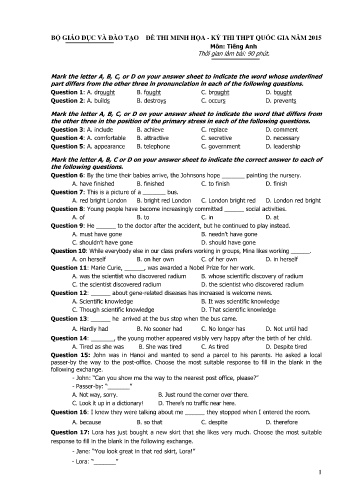
 BỘ GIÁO D ỤC VÀ ĐÀO T ẠO ĐỀ THI MINH H ỌA - KỲ THI THPT QU ỐC GIA N ĂM 2015
 Môn: Tiếng Anh
 Thời gian làm bài: 90 phút.
Mark the letter A, B, C, or D on your answer sheet to indicate the word whose underlined
part differs from the other three in pronunciation in each of the following questions.
Question 1: A. drought B. fought C. brought D. bought
Question 2: A. builds B. destroys C. occurs D. prevents
Mark the letter A, B, C, or D on your answer sheet to indicate the word that differs from
the other three in the position of the primary stress in each of the following questions.
Question 3: A. include B. achieve C. replace D. comment
Question 4: A. comfortable B. attractive C. secretive D. necessary
Question 5: A. appearance B. telephone C. government D. leadership
Mark the letter A, B, C or D on your answer sheet to indicate the correct answer to each of
the following questions.
Question 6: By the time their babies arrive, the Johnsons hope _______ painting the nursery.
 A. have finished B. finished C. to finish D. finish
Question 7: This is a picture of a _______ bus.
 A. red bright London B. bright red London C. London bright red D. London red bright
Question 8: Young people have become increasingly committed ______ social activities.
 A. of B. to C. in D. at
Question 9: He ______ to the doctor after the accident, but he continued to play instead.
 A. must have gone B. needn’t have gone
 C. shouldn’t have gone D. should have gone
Question 10 : While everybody else in our class prefers working in groups, Mina likes working ______.
 A. on herself B. on her own C. of her own D. in herself
Question 11 : Marie Curie, ______, was awarded a Nobel Prize for her work.
 A. was the scientist who discovered radium B. whose scientific discovery of radium
 C. the scientist discovered radium D. the scientist who discovered radium
Question 12 : ______ about gene-related diseases has increased is welcome news.
 A. Scientific knowledge B. It was scientific knowledge
 C. Though scientific knowledge D. That scientific knowledge
Question 13 : ______ he arrived at the bus stop when the bus came.
 A. Hardly had B. No sooner had C. No longer has D. Not until had
Question 14 : _______, the young mother appeared visibly very happy after the birth of her child.
 A. Tired as she was B. She was tired C. As tired D. Despite tired
Question 15: John was in Hanoi and wanted to send a parcel to his parents. He asked a local
passer-by the way to the post-office. Choose the most suitable response to fill in the blank in the
following exchange.
 - John: “Can you show me the way to the nearest post office, please?”
 - Passer-by: “_______”
 A. Not way, sorry. B. Just round the corner over there.
 C. Look it up in a dictionary! D. There’s no traffic near here.
Question 16 : I knew they were talking about me ______ they stopped when I entered the room.
 A. because B. so that C. despite D. therefore
Question 17: Lora has just bought a new skirt that she likes very much. Choose the most suitable
response to fill in the blank in the following exchange.
 - Jane: “You look great in that red skirt, Lora!”
 - Lora: “_______”
 1
 Question 34: The world is becoming more industrialized and the number of animal species that have
 A B
become extinct have increased.
 C D
Read the following passage and mark the letter A, B, C, or D on your answer sheet to
indicate the correct word or phrase that best fits each of the numbered blanks.
 Higher Education in the UK
 Students who have successfully completed an A-level course may go to university to do (35)
______ three- or four-year course leading to a first degree such as Bachelor of Arts (BA), Bachelor of
Science (BSc), etc. They apply to several universities which then (36) ______ an offer of a place
specifying the minimum grades the student needs to obtain in the A level subjects studied. Higher
education is not (37) ______. In principle, students have to pay a contribution to the cost of teaching
(tuition fees) and have also to pay their living costs (maintenance). The government provides (38)
______ to help them pay for university education which have to be paid back from earnings once their
income reaches a certain (39) ______. In recent years government policy has been to (40)______ the
percentage of 18-year olds (41)______ go to university, which is now, at 40%, double the 1990
figure, but this growth has been at the (42) ______ of the amount of financial support given to
individual students.
 Universities receive money (43) ______ the state for each student and are responsible for
employing staff and deciding which courses to offer. The head of a university, who is (44) ______ for
its management, is called a vice-chancellor.
Question 35: A. that B. a C. this D. the
Question 36: A. create B. do C. make D. get
Question 37: A. permitted B. allowed C. compulsory D. free
Question 38: A. loans B. hires C. shares D. rents
Question 39: A. grade B. level C. mark D. rank
Question 40: A. rise B. remain C. increase D. decrease
Question 41: A. who B. which C. whose D. whom
Question 42: A. fee B. suspense C. charge D. expense
Question 43: A. of B. from C. to D. in
Question 44: A. liable B. responsible C. answerable D. chargeable
Read the following passage and mark the letter A, B, C or D on your answer sheet to
indicate the correct answer to each of the questions from 45 to 54.
 Early peoples had no need of engineering works to supply their water. Hunters and nomads
camped near natural sources of fresh water, and populations were so sparse that pollution of the water
supply was not a serious problem. After community life developed and agricultural villages became
urban centres, the problem of supplying water became important for inhabitants of a city, as well as for
irrigation of the farms surrounding the city. Irrigation works were known in prehistoric times, and before
2000 BC the rulers of Babylonia and Egypt constructed systems of dams and canals to impound the
flood waters of the Euphrates and Nile rivers, controlling floods and providing irrigation water
throughout the dry season. Such irrigation canals also supplied water for domestic purposes. The first
people to consider the sanitation of their water supply were the ancient Romans, who constructed a vast
system of aqueducts to bring the clean waters of the Apennine Mountains into the city and built basins
and filters along these mains to ensure the clarity of the water. The construction of such extensive
water-supply systems declined when the Roman Empire disintegrated, and for several centuries local
springs and wells formed the main source of domestic and industrial water.
 The invention of the force pump in England in the middle of the 16th century greatly
extended the possibilities of development of water-supply systems. In London, the first pumping
waterworks was completed in 1562; it pumped river water to a reservoir about 37 m above the level
 3
 Our night’s sleep does not just consist of a steady phase of gradually deepening sleep. It
alternates between two stages: Non-dreaming or ordinary sleep, and REM (rapid eye movement) or
dreaming sleep. As soon as we fall asleep, we go straight into non-dreaming sleep for an hour or so,
then into REM sleep for about 15 minutes, then back into non-dreaming sleep. It alternates in this
way for the rest of the night, with non-dreaming sleep tending to last longer at the beginning of the
night. Non-dreaming sleep occupies three-quarters of our night’s sleep, about a quarter of it deep
and the rest fairly light.
 It is widely believed that sleep repairs the body and makes good the damage caused by being
awake. However, its main function is to refresh the brain. Experts believe that probably only about
two-thirds of our sleep is necessary for repairing and refreshing the brain, with the most valuable
sleep coming in the first few hours of the non-dreaming period, the last few hours of sleep are not so
essential. The brain can manage quite well with reduced sleep as long as it is uninterrupted sleep.
 The quality of sleep is important. A study conducted in the USA looked at short sleepers, who
slept for 5.5 hours on average, and long sleepers, who had 8.5 hours or more. It is discovered after a
variety of tests that the long sleepers were poor sleepers, had twice as much REM sleep as the short
sleepers, appeared to sleep longer to make up for poor sleep, and did not wake up in the morning
refreshed. Similarly, people who sleep deeply do not necessarily get a better quality of sleep than
shallow sleepers. Deep sleepers can feel tired the following day, so six hours of good sleep is worth
more than eight hours of troubled sleep.
 From Awakening to Sleep – American Psychological Association
Question 55: It can be concluded from the first paragraph that ______.
 A. people need equal time of sleep
 B. sleep remains a puzzle
 C. sleep is among the processes of the nature
 D. everything about sleep has been brought to light
Question 56: The word “ irritating ” in paragraph 1 is closest in meaning to ______.
 A. calming B. soothing C. annoying D. comforting
Question 57: All the following statements are true, EXCEPT for ______.
 A. our night’s sleep occurs in a straight line of only two phases
 B. all sleeps are similar in the alternatives of the two stages during the night
 C. we spend only 25 percent of our night’s sleeping time dreaming
 D. we often have no dreams right after we fall asleep
Question 58: The word “ it ” in paragraph 2 refers to ______.
 A. our night’s sleep B. the ordinary sleep
 C. the REM D. the night
Question 59: The word “ occupies ” in paragraph 2 could be best replaced by ______.
 A. accounts for B. takes care of C. works out D. goes up
Question 60: Unlike the common belief, sleep helps ______.
 A. not to be awake C. us to fix the damage happening by day
 B. us to repair our body D. our brain to rest and recover
Question 61: The study discussed in the reading passage suggests that ______.
 A. the fewer hours we sleep, the more we dream
 B. deep sleep means better sleep
 C. the type of sleep is more important than its length
 D. six hours of sleep is better than eight hours
 5
File đính kèm:
- de_thi_minh_hoa_ky_thi_thpt_quoc_gia_nam_2015_mon_tieng_anh.pdf

