

Đề thi tham khảo - Kỳ thi trung học phổ thông quốc gia năm 2020 môn Tiếng Anh (Có đáp án)
Mark the letter A, B, C, or D on your answer sheet to indicate the word whose underlined part differs from the other three in pronunciation in each of the following questions.
Question 1 (NB): A. attends B. appears C. accepts D. complains
Question 2 (NB): A. light B. rise C. mile D. gift
Mark the letter A, B, C, or D on your answer sheet to indicate the word that differs from the other three in the position of primary stress in each of the following questions.
Question 3 (NB): A. respect B. marry C. depend D. predict
Question 4 (NB): A. fantastic B. powerful C. sensitive D. personal
Mark the letter A, B, C, or D on your answer sheet to indicate the correct answer to each of the following questions.
 21 trang
04/02/2026
630
21 trang
04/02/2026
630
Bạn đang xem 20 trang mẫu của tài liệu "Đề thi tham khảo - Kỳ thi trung học phổ thông quốc gia năm 2020 môn Tiếng Anh (Có đáp án)", để tải tài liệu gốc về máy hãy click vào nút Download ở trên.
Tóm tắt nội dung tài liệu: Đề thi tham khảo - Kỳ thi trung học phổ thông quốc gia năm 2020 môn Tiếng Anh (Có đáp án)
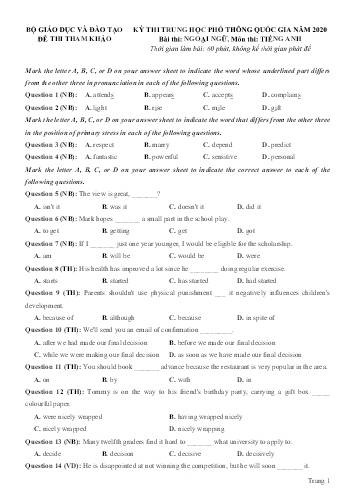
BỘ GIÁO DỤC VÀ ĐÀO TẠO KỲ THI TRUNG HỌC PHỔ THÔNG QUỐC GIA NĂM 2020
 ĐỀ THI THAM KHẢO Bài thi: NGOẠI NGỮ. Môn thi: TIẾNG ANH
 Thời gian làm bài: 60 phút, không kể thời gian phát đề
Mark the letter A, B, C, or D on your answer sheet to indicate the word whose underlined part differs
from the other three in pronunciation in each of the following questions.
Question 1 (NB): A. attends B. appears C. accepts D. complains
Question 2 (NB): A. light B. rise C. mile D. gift
Mark the letter A, B, C, or D on your answer sheet to indicate the word that differs from the other three
in the position of primary stress in each of the following questions.
Question 3 (NB): A. respect B. marry C. depend D. predict
Question 4 (NB): A. fantastic B. powerful C. sensitive D. personal
Mark the letter A, B, C, or D on your answer sheet to indicate the correct answer to each of the
following questions.
Question 5 (NB): The view is great, _______?
 A. isn't it B. was it C. doesn't it D. did it
Question 6 (NB): Mark hopes _______ a small part in the school play.
 A. to get B. getting C. get D. got
Question 7 (NB): If I _______ just one year younger, I would be eligible for the scholarship.
 A. am B. will be C. would be D. were
Question 8 (TH): His health has improved a lot since he ________ doing regular exercise.
 A. starts B. started C. has started D. had started
Question 9 (TH): Parents shouldn't use physical punishment ___ it negatively influences children's
development.
 A. because of B. although C. because D. in spite of
Question 10 (TH): We'll send you an email of confirmation _________.
 A. after we had made our final decision B. before we made our final decision
 C. while we were making our final decision D. as soon as we have made our final decision
Question 11 (TH): You should book _______ advance because the restaurant is very popular in the area.
 A. on B. by C. with D. in
Question 12 (TH): Tommy is on the way to his friend's birthday party, carrying a gift box _____
colourful paper.
 A. were nicely wrapped B. having wrapped nicely
 C. nicely wrapped D. nicely wrapping
Question 13 (NB): Many twelfth graders find it hard to _______ what university to apply to.
 A. decide B. decision C. decisive D. decisively
Question 14 (VD): He is disappointed at not winning the competition, but he will soon _______ it.
 Trang 1
Read the following passage and mark the letter A, B, C, or D on your answer sheet to indicate the
correct word or phrase that best fits each of the numbered blanks from 25 to 29.
 Ecotourism
 The primary aim of ecotourism is to educate the traveller and bring him or her closer to nature.
Participants are given the chance to visit parts of the world (25) ______ are untouched by human
intervention and to engage in conservation work and various other kinds of environmental projects.
 Visitors benefit by gaining an appreciation of natural habitats and an (26) ______ into the impact of
human beings on the environment. Local communities gain financially but also in (27) ______ ways,
since not only monuments but other buildings as well, such as bridges or windmills, are restored in order
to attract more visitors.
 (28) ______, there are also disadvantages to this type of tourism. There have been cases in which
tourism has been allowed to develop with no control or limits. As a result, (29) ______ cultures have been
affected or even threatened by foreign lifestyles. Many people today support that our approach to the
development of ecotourism has to be reconsidered. It is essential that this type of tourism be
environmentally, socially, and culturally friendly.
Question 25 (NB): A. who B. that C. when D. why
Question 26 (VD): A. advent B. intent C. access D. insight
Question 27 (TH): A. other B. another C. every D. one
Question 28 (TH): A. Although B. Therefore C. However D. Moreover
Question 29 (VD): A. primary B. peculiar C. indigenous D. exotic
Read the following passage and mark the letter A, B, C, or D on your answer sheet to indicate the
correct answer to each of the questions from 30 to 34.
 Parents complain that it is difficult to live with teenagers. Then again, teenagers say exactly the same
thing about their parents! According to a recent survey, the most common arguments between parents and
teenagers are those regarding untidiness and household chores. On the one hand, parents go mad over
untidy rooms, clothes dropped on the floor and their children's refusal to help with the housework. On the
other hand, teenagers lose their patience continually when parents tell them off for dropping the towel in
the bathroom, not cleaning up their room or refusing to do the shopping at the supermarket.
 The survey, conducted by St George University, showed that different parents have different
approaches to these problems. However, some approaches are much more successful than others. For
example, those parents who yell at their teens for their untidiness, but later clear up after them, have fewer
chances of changing their teens' behaviour. On the contrary, those who let teenagers experience the
consequences of their actions are more successful. For instance, when teenagers who don't help their
parents with the shopping don't find their favourite food in the fridge, they are forced to reconsider their
actions.
 Trang 3
 She added: “We want to underscore that every question asked by our tutors has a purpose, and that
purpose is to assess how students think about their subject and respond to new information or unfamiliar
ideas. No matter what kind of educational background or opportunities you have had, the interview
should be an opportunity to present your interest and ability in your chosen subject, since they are not just
about reciting what you already know."
 Laura Tunbridge, from St Catherine's College, explained why a music candidate might be asked to
explain the different ways they listen to music. “The question allows students to use their own musical
experiences as a starting point for a broader and more abstract discussion about the different ways people
consume music, the relationship between music and technology, and how music can define us socially,”
she said.
 Candidates who successfully clear the first hurdle with their written application will be invited to
interview. “We know there are still misunderstandings about the Oxford interview, so we put as much
information as possible out there to allow students to see the reality of the process," added Dr Khan.
Question 35 (VDC): Which of the following best serves as the title for the article?
 A. Oxford University: Lowering Standards in Times of Change!
 B. The History of Oxford's Interviewing Schemes
 C. Oxford University Interview Questions: Would You Pass the Test?
 D. The Oxford's Guide to Success in Job Interviews
Question 36 (TH): The word "them” in paragraph 1 refers to ______.
 A. prospective earth sciences students B. historians
 C. chemistry candidates D. questions
Question 37 (TH): Why has Oxford University publicised its sample interview questions and related
advice?
 A. To prepare students for unfamiliar questions in their job interviews
 B. To familiarise potential applicants with their interview process
 C. To test public reaction to their novel interview process
 D. To reduce confusion among most of their current students
Question 38 (VD): The word “reciting” in paragraph 3 most probably means __________.
 A. repeating B. reassessing C. releasing D. revising
Question 39 (TH): According to Laura Tunbridge, the question about a candidate's ways of listening to
music is intended to ______.
 A. judge the candidate's ability to react to familiar situations
 B. set the context for a more abstract discussion on music-related topics
 C. encourage the candidate to elaborate on their individual preferences
 D. measure their understanding of how technology affects entertainment choices
Question 40 (TH): The word “clear” in paragraph 5 is closest in meaning to ______.
 Trang 5
 A. You may take photos in the museum. B. You should take photos in the museum.
 C. You mustn't take photos in the museum. D. You needn't take photos in the museum.
Mark the letter A, B, C, or D on your answer sheet to indicate the sentence that best combines each
pair of sentences in the following questions.
Question 49 (VDC): The film is not perfect. Its abrupt ending spoils it.
 A. The film would be perfect if it ended abruptly.
 B. Provided the film ended abruptly, it would not be perfect.
 C. Unless the film ends abruptly, it won't be perfect.
 D. But for its abrupt ending, the film would be perfect.
Question 50 (VDC): Olga handed in her exam paper. She then realised that she had missed one question.
 A. Having realised that she had missed one question, Olga handed in her exam paper.
 B. Not until Olga had handed in her exam paper did she realise that she had missed one question.
 C. Had Olga realised that she had missed one question, she wouldn't hand in her exam paper.
 D. Only after Olga realised that she had missed one question did she hand in her exam paper.
 Đáp án
 1-C 2-D 3-B 4-A 5-A 6-A 7-D 8-B 9-C 10-D
 11-D 12-C 13-A 14-B 15-B 16-D 17-A 18-C 19-D 20-A
 21-C 22-B 23-C 24-A 25-B 26-D 27-A 28-C 29-C 30-A
 31-D 32-B 33-D 34-A 35-C 36-A 37-B 38-A 39-B 40-A
 41-D 42-C 43-A 44-C 45-A 46-B 47-C 48-C 49-D 50-B
 LỜI GIẢI CHI TIẾT
Question 1: Đáp án C
Kiến thức: Phát âm đuôi “s”
Giải chi tiết:
A. attends /əˈtendz/
B. appears /əˈpɪə(r)z/
C. accepts /əkˈsepts/
D. complains /kəmˈpleɪnz/
Quy tắc: Có 3 cách phát âm phụ âm cuối “s”:
- /s/: Khi từ có phát âm tận cùng là các phụ âm vô thanh /p/, k/, /f/, /ð/, /t/
- /ɪz/: Khi từ có phát âm tận cùng là các âm /s/, /ʃ/, /tʃ/, /z/, /ʒ/, /dʒ/ (thường có tận cùng là các chữ cái ce,
x, z, sh, ch, s, ge, ss)
- /z/: Khi từ có tận cùng là các nguyên âm và các phụ âm còn lại.
Phần gạch chân phương án C được phát âm là /s/, còn lại phát âm là /z/.
Question 2: Đáp án D
 Trang 7
File đính kèm:
- de_thi_tham_khao_ky_thi_trung_hoc_pho_thong_quoc_gia_nam_202.pdf

