

Đề thi thử THPT quốc gia năm 2017 môn Tiếng Anh (Lần 1) - Mã đề 169 - Trường THPT Chuyên Đại học Vinh
Mark the letter A, B, C, or D on your answer sheet to indicate the most suitable response to complete each of the following exchanges.
Question 1: Thomas and Peter are meeting after a long time.
Thomas: “How have you been recently?” Peter: “_____”
A. I am going on holiday next week.
B. Pretty busy, I think.
C. By car, usually.
D. I am working here.
Question 2: George and Frankie are talking about their hobbies.
George: “In my opinion, action films are exciting”. Frankie: “_____”
A. What are opinion!
B. There‟s no doubt about it.
C. Yes, you can do it.
D. Your opinion is exactly.
 4 trang
05/02/2026
840
4 trang
05/02/2026
840
Bạn đang xem tài liệu "Đề thi thử THPT quốc gia năm 2017 môn Tiếng Anh (Lần 1) - Mã đề 169 - Trường THPT Chuyên Đại học Vinh", để tải tài liệu gốc về máy hãy click vào nút Download ở trên.
Tóm tắt nội dung tài liệu: Đề thi thử THPT quốc gia năm 2017 môn Tiếng Anh (Lần 1) - Mã đề 169 - Trường THPT Chuyên Đại học Vinh
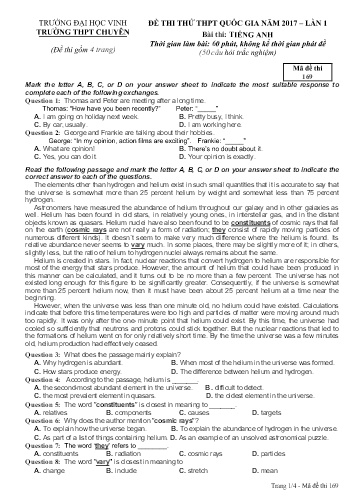
 TRƯỜNG ĐẠI HỌC VINH ĐỀ THI THỬ THPT QUỐC GIA NĂM 2017 – LẦN 1
 TRƯỜNG THPT CHUYÊN Bài thi: TIẾNG ANH
 Thời gian làm bài: 60 phút, không kể thời gian phát đề
 (Đề thi gồm 4 trang) (50 câu hỏi trắc nghiệm)
 Mã đề thi
 169
Mark the letter A, B, C, or D on your answer sheet to indicate the most suitable response to
complete each of the following exchanges.
Question 1: Thomas and Peter are meeting after a long time.
 Thomas: “How have you been recently?” Peter: “_____”
 A. I am going on holiday next week. B. Pretty busy, I think.
 C. By car, usually. D. I am working here.
Question 2: George and Frankie are talking about their hobbies.
 George: “In my opinion, action films are exciting”. Frankie: “_____”
 A. What are opinion! B. There‟s no doubt about it.
 C. Yes, you can do it. D. Your opinion is exactly.
Read the following passage and mark the letter A, B, C, or D on your answer sheet to indicate the
correct answer to each of the questions.
 The elements other than hydrogen and helium exist in such small quantities that it is accurate to say that
the universe is somewhat more than 25 percent helium by weight and somewhat less than 75 percent
hydrogen.
 Astronomers have measured the abundance of helium throughout our galaxy and in other galaxies as
well. Helium has been found in old stars, in relatively young ones, in interstellar gas, and in the distant
objects known as quasars. Helium nuclei have also been found to be constituents of cosmic rays that fall
on the earth (cosmic rays are not really a form of radiation; they consist of rapidly moving particles of
numerous different kinds). It doesn`t seem to make very much difference where the helium is found. Its
relative abundance never seems to vary much. In some places, there may be slightly more of it; in others,
slightly less, but the ratio of helium to hydrogen nuclei always remains about the same.
 Helium is created in stars. In fact, nuclear reactions that convert hydrogen to helium are responsible for
most of the energy that stars produce. However, the amount of helium that could have been produced in
this manner can be calculated, and it turns out to be no more than a few percent. The universe has not
existed long enough for this figure to be significantly greater. Consequently, if the universe is somewhat
more than 25 percent helium now, then it must have been about 25 percent helium at a time near the
beginning.
 However, when the universe was less than one minute old, no helium could have existed. Calculations
indicate that before this time temperatures were too high and particles of matter were moving around much
too rapidly. It was only after the one- minute point that helium could exist. By this time, the universe had
cooled so sufficiently that neutrons and protons could stick together. But the nuclear reactions that led to
the formations of helium went on for only relatively short time. By the time the universe was a few minutes
old, helium production had effectively ceased.
Question 3: What does the passage mainly explain?
 A. Why hydrogen is abundant. B. When most of the helium in the universe was formed.
 C. How stars produce energy. D. The difference between helium and hydrogen.
Question 4: According to the passage, helium is _______.
 A. the second-most abundant element in the universe. B. difficult to detect.
 C. the most prevalent element in quasars. D. the oldest element in the universe.
Question 5: The word "constituents" is closest in meaning to _______.
 A. relatives B. components C. causes D. targets
Question 6: Why does the author mention "cosmic rays"?
 A. To explain how the universe began. B. To explain the abundance of hydrogen in the universe.
 C. As part of a list of things containing helium. D. As an example of an unsolved astronomical puzzle.
Question 7: The word „they‟ refers to ________.
 A. constituents B. radiation C. cosmic rays D. particles
Question 8: The word "vary" is closest in meaning to
 A. change B. include C. stretch D. mean
 Trang 1/4 - Mã đề thi 169
 C. When living abroad, it is important for us to create a balance between being open sociably and
keeping our own values personally.
 D. Although we live abroad, it is important for us to create a balance between being open sociably and
keeping your own values personally.
Question 24: The students may be intelligent. They will not get used to dealing with practical situations.
 A. The students may be too intelligent to get used to dealing with practical situations.
 B. Intelligent as they may be, the students will not get used to dealing with practical situations.
 C. Intelligent as may be the students, they will get used to dealing with practical situations.
 D. The students will get used to dealing with practical situations although they are intelligent.
Mark the letter A, B, C, or D on your answer sheet to indicate the word whose underlined part is
pronounced differently from that of the rest in each of the following questions.
Question 25: A. sounds B. situations C. obstacles D. secrets
Question 26: A. tale B. shape C. accurate D. date
 Mark the letter A, B, C, or D on your answer sheet to indicate the sentence that is closest in
meaning to each of the following questions.
Question 27: “He is always arguing with his new classmate”. She said.
 A. She informed that he was always arguing with his new classmate.
 B. She said that he didn‟t like his new classmate.
 C. She explained that his new classmate was noisy.
 D. She complained that he was always arguing with his new classmate.
Question 28: Is anyone checking your essay about the environmental pollution?
 A. Are you having someone to check your essay about the environmental pollution?
 B. Are you checking your essay about the environmental pollution?
 C. Are you going to check your essay about the environmental pollution?
 D. Are you having your essay about the environmental pollution checked?
Question 29: A new book is twice as expensive as an old one.
 A. An old book is more cheaper than a new one.
 B. A new book is twice the price of an old one.
 C. An old book is as twice as the price of the new one.
 D. A new book is so far more expensive than an old one.
Read the following passage and mark the letter A, B, C, or D on your answer sheet to indicate the
correct answer to each of the questions.
 A little more than a hundred years ago, a number of European scholars began to record stories being
told in peasant cottages and compile them into the first great collections of European folk tales. Written
evidence exists to prove that the folk tales they recorded existed long before then though. Collections of
sermons from the 12th to the 15th century show that medieval preachers knew of some of the same stories
as those recorded by the 19th century folklorists.
 The collections of folk tales made in the late 19th and early 20th centuries provide a rare opportunity to
make contact with the illiterate masses who have disappeared into the pass without leaving a trace. To
reject folk tales as historical evidence because they cannot be dated and situated with precision like other
historical documents is to turn one‟s back on one of the few points of entry into the previous centuries. But
to attempt to penetrate that world is to face a daunting set of obstacles, the greatest of which is the
impossibility of listening in on the story tellers. No matter how accurate they may be the versions of the
tales recorded in writing cannot convey the effects that the storytellers must have used to bring the stories
to life: the dramatic pauses, the sly glances, the use of gestures to set scenes, and the use of sounds to
punctuate actions. All of those devices shaped the meaning of the tales, and all of them elude the historian.
He cannot be sure that the limp and lifeless text he holds between the covers of a book provides an
accurate account of the performance that took place in earlier times.
Question 30: The author believes that written versions of folk tales _____.
 A. changed dramatically from the 19th to the 20th century.
 B. are valid historical documents.
 C. show how illiterate the masses were before the 19th century.
 D. should be rejected as historical evidence.
Question 31: What problems of folk tale collections does the author discuss?
 A. There is no way to tell which version of a story is the original system.
 B. They contain historical inaccuracies.
 C. They are used as historical evidence.
 D. They don‟t preserve the original performance style of the storytellers.
 Trang 3/4 - Mã đề thi 169
File đính kèm:
- de_thi_thu_thpt_quoc_gia_nam_2017_mon_tieng_anh_lan_1_ma_de.pdf

