

Đề thi thử THPT quốc gia năm 2017 môn Tiếng Anh (Lần 1) - Mã đề 195 - Trường THPT Chuyên Lương Văn Chánh
Mark the letter A, B, C, or D to indicate the word whose underlined part differs from the other three in pronunciation in each of the following questions.
Question 1: A. animal B. character C. imagine D. personality
Question 2: A. degree B. critical C. fertile D. minimum
Mark the letter A, B, C, or D to indicate the word that differs from the other three in the position of primary stress in each of the following questions.
Question 3: A. economics B. engineering C. information D. geography
Question 4: A. opponent B. vertical C. windsurfing D. penalty
 5 trang
05/02/2026
900
5 trang
05/02/2026
900
Bạn đang xem tài liệu "Đề thi thử THPT quốc gia năm 2017 môn Tiếng Anh (Lần 1) - Mã đề 195 - Trường THPT Chuyên Lương Văn Chánh", để tải tài liệu gốc về máy hãy click vào nút Download ở trên.
Tóm tắt nội dung tài liệu: Đề thi thử THPT quốc gia năm 2017 môn Tiếng Anh (Lần 1) - Mã đề 195 - Trường THPT Chuyên Lương Văn Chánh
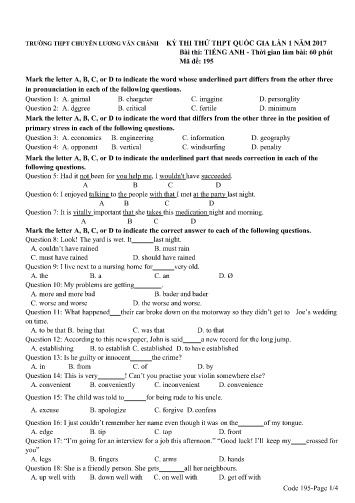
 TRƯỜNG THPT CHUYÊN LƯƠNG VĂN CHÁNH KỲ THI THỬ THPT QUỐC GIA LẦN 1 NĂM 2017
 Bài thi: TIẾNG ANH - Thời gian làm bài: 60 phút
 Mã đề: 195
Mark the letter A, B, C, or D to indicate the word whose underlined part differs from the other three
in pronunciation in each of the following questions.
Question 1: A. animal B. character C. imagine D. personality
Question 2: A. degree B. critical C. fertile D. minimum
Mark the letter A, B, C, or D to indicate the word that differs from the other three in the position of
primary stress in each of the following questions.
Question 3: A. economics B. engineering C. information D. geography
Question 4: A. opponent B. vertical C. windsurfing D. penalty
Mark the letter A, B, C, or D to indicate the underlined part that needs correction in each of the
following questions.
Question 5: Had it not been for you help me, I wouldn't have succeeded.
 A B C D
Question 6: I enjoyed talking to the people with that I met at the party last night.
 A B C D
Question 7: It is vitally important that she takes this medication night and morning.
 A B C D
Mark the letter A, B, C, or D to indicate the correct answer to each of the following questions.
Question 8: Look! The yard is wet. It last night.
 A. couldn’t have rained B. must rain
 C. must have rained D. should have rained
Question 9: I live next to a nursing home for very old.
 A. the B. a C. an D. Ø
Question 10: My problems are getting .
 A. more and more bad B. bader and bader
 C. worse and worse D. the worse and worse.
Question 11: What happened their car broke down on the motorway so they didn’t get to Joe’s wedding
on time.
 A. to be that B. being that C. was that D. to that
Question 12: According to this newspaper, John is said a new record for the long jump.
 A. establishing B. to establish C. established D. tohave established
Question 13: Is he guilty or innocent the crime?
 A. in B. from C. of D. by
Question 14: This is very ! Can’t you practise your violin somewhere else?
 A. convenient B. conveniently C. inconvenient D. convenience
Question 15: The child was told to for being rude to his uncle.
 A. excuse B. apologize C. forgive D. confess
Question 16: I just couldn’t remember her name even though it was on the of my tongue.
 A. edge B. tip C. top D. front
Question 17: “I’m going for an interview for a job this afternoon.” “Good luck! I’ll keep my crossed for
you”
 A. legs B. fingers C. arms D. hands
Question 18: She is a friendly person. She gets all her neighbours.
 A. up well with B. down well with C. on well with D. get off with
 Code 195-Page 1/4 Mark the letter A, B, C, or D to indicate the most suitable response to complete each of the following
exchanges.
Question 20: Susan accidentally stepped on Denise’s foot.
~Susan: “Oops! I’m sorry, Denise.” ~Denise: “ ”
 A. You shouldn’t do that. B. It’s alright.
 C. You are welcome. D. It’s nonsense.
Question 21: Mai and Nam are talking about the cell phone that Nam has just bought.
~Mai: “Wow, I’ve never seen such a nice cell phone, Nam” ~Nam: “ ”.
 A. Oh, I don’t know. B. Thank you. I’m glad you like it.
 C. You’re welcome. D. I agree with you.
Mark the letter A, B, C, or D to indicate the word CLOSEST in meaning to the underlined word in
each of the following questions.
Question 22: She was brought up in a well-off family. She can’t understand the problems we are facing.
 A. wealthy B. kind C. broke D. poor
Question 23: Father has lost his job, so we’ll have to tighten our belt to avoid getting into debt.
 A. earn money B. spend money C. sit still D. economize
Mark the letter A, B, C, or D to indicate the word(s) OPPOSITE in meaning to the underlined word(s)
in each of the following questions.
Question 24: Although it’s a long day for us, we feel we are contented with what we do.
 A. dissatisfied B. excited C. shocked D. interested
Question 25: Fruit and vegetables grew in abundance on the island. The islanders even exported the
surplus.
A. large quantity B. excess C. small quantity D. sufficiency
Mark the letter A, B, C, or D to indicate the sentence that is closest in meaning to each of the following
questions.
Question 26: We have run out of the items you want.
 A. We have to run out to buy the items you want.
 B. The items you want are out of our shop.
 C. For the items you want, we must run out.
 D. The items you want have been out of stock.
Question 27: She had only just begun to speak when people started interrupting.
 A. She hardly had begun to speak when people started interrupting.
 B. Hardly she had begun to speak when people started interrupting.
 C. Hardly had she begun to speak when people started interrupting.
 D. She hadn’t begun to speak when people startedinterrupting.
Question 28: “Leave my house now or I’ll call the police!” shouted the lady to the man.
 A. The lady threatened to call the police if the man didn’t leave her house.
 B. The lady said that she would call the police if the man didn’t leave her house.
 C. The lady told the man that she would call the police if he didn’t leave her house.
 D. The lady informed the man that she would call the police if he didn’t leave her house.
Mark the letter A, B, C, or D to indicate the sentence that best combines each pair of sentences in the
following questions.
Question 29: Marry loved her stuffed animal when she was young. She couldn’t sleep without it.
 A. When Marry was young, she loved her stuffed animal so as not to sleep with it.
 B. As Marry couldn’t sleep without her stuffed animal when she was young, she loved it.
 C. When Marry was young, she loved her stuffed animal though she couldn’t sleep without it.
 D. When Marry was young, she loved her stuffed animal so much that she couldn’t sleep without it.
Question 30: The fire-fighters made every effort to put off the flames. The building burned down completely.
 A. The building burned down completely though the fire-fighters made every effort to put off the flames.
 B. Had it not been for the fire-fighters’ every effort, the building would have burned downcompletely.
 Code 195-Page 2/4 Question 40. Why did the teachers ask each band to play two songs?
 A. To decide which songs to play at the picnic B. To see if the bands could play a variety of songs
 C. To make sure the contest did not go on too long D. To make the concert more enjoyable for
students
Question 41. According to the article, what is unusual about the band Four Square?
 A. It is named after a popular children’s game. B. Its members practice several times a week.
 C. It is a rock band with a violinist. D. Its members all play guitar.
Question 42. According to the article, what does the band Four Square hope to do in the future?
 A. Perform at the school picnic every year B. Perform in many different places
 C. Buy new instruments D. Record an album
Question 43. Who will play music at the picnic this year?
 A. Marisol Varga B. Mr. Lopez C. Peter Zandt D. Ms. Cho
Read the following passage and mark the letter A, B, C, or D to indicate the correct answer to each of
the questions from 44 to 50.
 Dodder is an unusual and unwanted plant that attacks other plants. Except for its flowers, the plant
looks like spaghetti noodles. Its almost leafless, thread–like stems hang down atop other plants that dodder
needs to stay alive. Dodder does not produce its own food. Instead, it steals it from other plants. It feeds by
sucking juices from the plant it is wrapped around, often making its host very weak or even killing it.
 Dodder can find other plants by their smell. When a dodder seedling starts growing, it follows the
scent of plants it prefers, like tomato plants, potato plants, or other farm crops.
 Unlike most plants that usually grow in the direction of light or warmth, a dodder plant will grow in
the direction of, for example, tomato odor––if a tomato happens to be growing nearby.
 However, a young dodder plant must find a host plant quickly. If it cannot catch a whiff of a
potential host within a few days, it will dry up and disappear—even if there is plenty of water around. Once
it finds a host, the young dodder plant will attach itself to it and start growing faster. At that point, the
dodder plant will drop its root.
 Dodder is thus a difficult weed to manage and a real headache for farmers. When it does get out of
hand, dodder can greatly reduce a farmer’s harvest or even destroy crops completely. Before sowing their
produce, farmers in warm parts of the world often check to make sure no unwanted dodder seeds have
intermingled with their crop seeds. This is a good way to stop dodder plants from sneaking their way into a
crop field.
Question 44. What is the main topic of the passage?
 A. A new variety of farm crop B. Plants that are harmful to humans
 C. The special abilities of a dangerous plant D. Recent improvements in farming methods
Question 45. Why does the author mention spaghetti?
 A. To analyze the content of some food B. To describe the shape of a dodder plant
 C. To explain where the dodder plant came from D. To argue that dodder plants can be used to make
food
Question 46. The word it refers to .
 A. host B. food C. plant D. dodder
Question 47. What causes dodder to grow in a particular direction?
 A. Odor B. Light C. Water D. Temperature
Question 48. The expression catch a whiff is closest in meaning to .
 A. eat the seeds B. notice the smell C. find the location D. determine the size
Question 49. What will happen if a dodder plant starts growing where there are no other plants around?
 A. It will soon die. B. It will grow deeper roots.
 C. It will attract other plants. D. It will cover the entire area of soil.
Question 50. The expression get out of hand is closest in meaning to .
 A. dry up and die B. change its color C. become hard to find D. grow uncontrollably
 Code 195-Page 4/4
File đính kèm:
- de_thi_thu_thpt_quoc_gia_nam_2017_mon_tieng_anh_lan_1_ma_de.pdf

