

Ôn tập kiến thức học kỳ 2 môn Tiếng Anh 10 - Unit 9: Preserving the environment - Năm học 2019-2020 - Trường THPT Nguyễn Thái Học
* EXERCISES
I. WORD FORMS: Supply the correct word form.
1. People should change their habit of using plastic bags to contribute to environmental __________. (preserve)
2. One of the causes of massive _________________ is a lack of awareness of a few local people. (forest)
3. A ___________ energy system converts the energy found in sunlight, wind, falling water, waves, geothermal heat, or biomass. (renew)
4. The energy ___________ of the community has increased since the new resort was built. (consume)
5. The coastal areas have been severely ______________ by the disposals of harmful chemical rubbish. (pollute)
6. Could you _________ the picture over the sofa? (straight)
7. I found the visit most _________. (education)
8. The police are interested in the sudden _________ of the valuable paintings. (appear)
II. GAP-FILL: Complete the sentences, using the given words/ phrases in the box:
 11 trang
01/12/2025
1180
11 trang
01/12/2025
1180
Tóm tắt nội dung tài liệu: Ôn tập kiến thức học kỳ 2 môn Tiếng Anh 10 - Unit 9: Preserving the environment - Năm học 2019-2020 - Trường THPT Nguyễn Thái Học
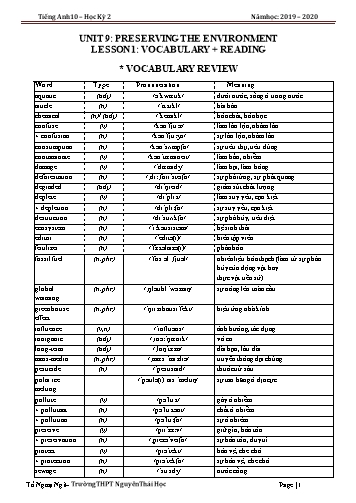
Tiếng Anh 10 – Học Kỳ 2 Năm học: 2019 – 2020 UNIT 9: PRESERVING THE ENVIRONMENT LESSON 1: VOCABULARY + READING * VOCABULARY REVIEW Word Type Pronunciation Meaning aquatic (adj) /əˈkwætɪk/ dưới nước, sống ở trong nước article (n) /ˈɑːtɪkl/ bài báo chemical (n)/ (adj) /ˈkemɪkl/ hóa chất, hóa học confuse (v) /kənˈfjuːz/ làm lẫn lộn, nhầm lẫn + confusion (n) /kənˈfjuːʒn/ sự lẫn lộn, nhầm lẫn consumption (n) /kənˈsʌmpʃn/ sự tiêu thụ, tiêu dùng contaminate (v) /kənˈtæmɪneɪt/ làm bẩn, nhiễm damage (v) /ˈdæmɪdʒ/ làm hại, làm hỏng deforestation (n) /ˌdiːˌfɒrɪˈsteɪʃn/ sự phá rừng, sự phát quang degraded (adj) /dɪˈɡreɪd/ giảm sút chất lượng deplete (v) /dɪˈpliːt/ làm suy yếu, cạn kiệt + depletion (n) /dɪˈpliːʃn/ sự suy yếu, cạn kiệt destruction (n) /dɪˈstrʌkʃn/ sự phá hủy, tiêu diệt ecosystem (n) /ˈiːkəʊsɪstəm/ hệ sinh thái editor (n) /ˈedɪtə(r)/ biên tập viên fertilizer (n) /ˈfɜːtəlaɪzə(r)/ phân bón fossil fuel (n.phr) /ˈfɒs.əl ˌfjʊəl/ nhiên liệu hóa thạch (làm từ sự phân hủy của động vật hay thực vật tiền sử) global (n.phr) /ˌɡləʊbl ˈwɔːmɪŋ/ sự nóng lên toàn cầu warming greenhouse (n.phr) /ˈɡriːnhaʊsɪˈfekt/ hiệu ứng nhà kính effect influence (v,n) /ˈɪnfluəns/ ảnh hưởng, tác dụng inorganic (adj) /ˌɪnɔːˈɡænɪk/ vô cơ long-term (adj) /ˌlɒŋˈtɜːm/ dài hạn, lâu dài mass-media (n.phr) /ˌmæs ˈmiːdiə/ truyền thông đại chúng pesticide (n) /ˈpestɪsaɪd/ thuốc trừ sâu polar ice /ˈpəʊlə(r) aɪs ˈmeltɪŋ/ sự tan băng ở địa cực melting pollute (v) /pəˈluːt/ gây ô nhiễm + pollutant (n) /pəˈluːtənt/ chất ô nhiễm + pollution (n) /pəˈluːʃn/ sự ô nhiễm preserve (y) /prɪˈzɜːv/ giữ gìn, bảo tồn + preservation (n) /ˌprezəˈveɪʃn/ sự bảo tồn, duy trì protect (v) /prəˈtekt/ bảo vệ, che chở + protection (n) /prəˈtekʃn/ sự bảo vệ, che chở sewage (n) /ˈsuːɪdʒ/ nước cống Tổ Ngoại Ngữ - Trường THPT Nguyễn Thái Học Page | 1 Tiếng Anh 10 – Học Kỳ 2 Năm học: 2019 – 2020 8. The natural environment has been seriously influenced and degraded by human activities through many decades. A. worsened B. damaged C. destroyed D. reduced Choose the word(s) OPPOSITE in meaning to the underlined word(s) in each of the following questions. 9. Soil pollution leads to lack of fertile land to grow enough food for an increasing population. A. arid B. rich C. unclean D. deserted 10. Global warming may lead to many negative changes, including harsher weather conditions. A. more unbearable B. milder C. more extreme D. more serious IV. READING: A. Choose the word or phrase to fill in the blanks in the following passage: Nowadays, people are more aware that wildlife all over the world is in (1)_______. Many species of animals are threatened, and could easily become (2)_______ if we do not make an effort to protect them. There are many reasons for this. In some cases, animals are (3)_______ for their fur or for other valuable parts of their bodies. Some birds, (4)_______ as parrots, are caught alive and sold as pets. For many animals and birds, the problem is that their habitat - the place where they live - is (5)_______. More and more land is used for farms, for houses and for industry. All the Earth is being polluted seriously. If we do not control our action, there will be only one successful animals on the Earth - human beings. 1. A. problem B. vanishing C. threat D. danger 2. A. appeared B. empty C. bloomed D. extinct 3. A. game B. chased C. hunted D. extinct 4. A. like B. such C. or D. where 5. A. disappearing B. disappears C. being disappeared D. disappeared B. Read a text and answer the questions that follow. THE BALANCE OF NATURE All the different plants and animals in a natural community are in a state of balance. This balance is achieved by the plants and animals interacting with each other and with their non-living surroundings. The plants of a community are the producers: they use carbon dioxide, oxygen, nitrogen to build up their tissues using energy in the form of sunlight. The plant tissues form food for the plant-eating animals (herbivores) which are in turn eaten by flesh-eating animals (carnivores). Thus, plants produce the basic food supply for all the animals of a community. The animals themselves are the consumers, and are either herbivores or carnivores. Examples of herbivores in a woodland community are rabbits, deer, mice and snails, and insects such as aphids and caterpillars. The herbivores are sometimes eaten by the carnivores. Woodland carnivores are of all sizes, from insects such as beetles and lacewings to animals such as owls, shrews and foxes. Some carnivores feed on herbivores, some feed on the smaller carnivores, while some feed on both: a tawny owl will eat beetles and shrews as well as voles and mice. These food relationships between the different members of the community are known as food chains or food webs. All food chains start with plants. The links of the chain are formed by the herbivores that eat the plants and the carnivores that feed on the herbivores. There are more organisms at the base of the food chain than at the top; for example, there are many more green plants than carnivores in a community. Another important section of the community is made up of the decomposers. They include the bacteria and fungi that live in the soil and feed on dead animals and plants. By doing this they break down the tissues of the dead organisms and release mineral salts into the soil. 1. Which of the following statements is TRUE? A. All the plants in a wood are eaten by animals. B. All the animals in a wood depend on plants for their food supply. C. Plants and animals in a natural community do not interact with their non-living surroundings. D. The balance of a natural community means there is no primary species. 2. All of the following statements are true, EXCEPT ____. A. some animals eat other animals B. plants depend on the sun to grow C. plants depend on the gasses in the atmosphere to grow D. not every food chain starts with plants 3. Which of the following is NOT an example of carnivores? Tổ Ngoại Ngữ - Trường THPT Nguyễn Thái Học Page | 3 Tiếng Anh 10 – Học Kỳ 2 Năm học: 2019 – 2020 UNIT 9: PRESERVING THE ENVIRONMENT LESSON 2: LEXICO - GRAMMAR * GRAMMAR REVIEW I. REPORTED SPEECH 1. Statement: Câu tường thuật Form: S + asked / told sb + that + Mệnh đề lùi thì Ex: “I will come back tomorrow” Mary said. Mary said that she would come back the next day. Note: said => said that said to sb => told sb that 2. Command: Câu yêu cầu, đề nghị Form: S+ asked / told + sb + (not) + to V Ex: “Don't talk in class” The teacher said to us. The teacher told us not to talk in class. 3. Yes / No Questions Form: S + asked + (sb) + if / whether + Mệnh đề lùi thì Ex: "Can you speak English, Diep?" I asked. I asked Diep if she could speak English. 4. Wh-Question Form: S + asked + (sb) + Wh + Mệnh đề lùi thì Ex: “Where are you from?” He asked me He asked me where I were from. 5. Không lùi thì Form: S+ V (hiện tại) + (sb) + Mệnh để không lùi thì Ex: “I'm very exhausted now” she says. She says she is very exhausted now. * BẢNG LÙI THÌ DIRECT SPEECH REPORTED SPEECH Simple present Simple past Present continuous Past continuous Present perfect Past perfect Simple past Past perfect Past continuous Past perfect continuous Future (will/shall) Future in the past (would/ should) Near future (be going to V) Was/were going to V Can Could May Might Must Had to Needn’t Didn’t have to * BẢNG LÙI TRẠNG NGỮ Tổ Ngoại Ngữ - Trường THPT Nguyễn Thái Học Page | 5 Tiếng Anh 10 – Học Kỳ 2 Năm học: 2019 – 2020 ... 3. “Are you a student?” the woman asked the boy. ... 4. The captain said to them: “Wait here until I come back”. ... 5. “I’ll finish it by the end of this week,” he said. He promised... 6. “You shouldn’t use your cars for short distances,” the teacher said. The teacher advised her students .. V. MULTIPLE CHOICE QUESTIONS: Choose the best option. 1. "He can juggle five balls!" said Angie. Angie said he ____ five balls. A. juggled B. had juggled C. would juggle D. could juggle 2. “You must give me your essays," Mrs Vine said. Mrs Vine said we ____ give her our essays. A. were having to B. would have to C. had to D. must 3. I asked the man next to me ____ me the salt. A. pass B. if he passes C. to pass D. if he would pass 4. "Would you mind waiting for a moment?" the shop assistant asked the woman. The shop assistant asked the woman ____ for a moment. A. to wait B. waiting C. if she waits D. if she minds waiting 5. “Please don't leave your dirty football boots in the hall," Mum said to Doug. Mum told Doug ____ dirty football boots in the hall. A. that he doesn't leave his B. not to leave his C. not to leave your D. don't leave his 6. "Could you tell us where you were at six o'clock?" the police officer asked Barry. The police officer asked Barry ____ had been at six o'clock. A. telling him where you B. where he tells him he C. to tell him where you D. to tell him where he 7. "Could I have your e-mail address?" I asked Mariella. I asked Mariella ____ e -mail address. A. to give me her B. give me your C. give me her D. gave me your 8. "Can I have a new Xbox for my birthday?" I asked my mum. I asked my mum ____ a new Xbox for my birthday. A. that she gets me B. get me C. to get me D. if she could have me 9. "What's your name?" she asked me. She asked me ____. A. what your name is B. what your name was C. what my name is D. what my name was 10. "Are you a student?" the man asked the boy. The man wanted to know ____. A. if I was a student B. if the boy was a student C. if I am a student D. if the boy is a student 11. "What school are you going to?" he asked me. He wanted to know ____. A. what school am I going to B. what school you are going to C. what was the school I go to D. what school I was going to 12. "I won't be home this evening because I have to work late," Mike said. Mike said that ____. A. I wouldn't be home this evening because I had to work late B. he wouldn't be home this evening because he had to work late C. he won't be home this evening because he has to work late D. he wouldn't be home that evening because he had to work late Choose the underlined part that needs correction in each of the following questions: 13. Tim called yesterday and said he needed the report right now. A. called B. said C. needed D. now 14. Rosy said that she will come back there on another project the following year. A. said B. will come back C. there D. the following 15. The teacher asked his students to focus on your topic. A. asked B. his students C. to focus D. your 16. Mr Jones told his children not to wasting fresh water. A. told B. his children C. not to D. wasting Tổ Ngoại Ngữ - Trường THPT Nguyễn Thái Học Page | 7
File đính kèm:
- on_tap_kien_thuc_hoc_ky_2_mon_tieng_anh_10_unit_9_preserving.doc

