

Ôn tập kiến thức môn Tiếng Anh 10 - Unit 8: New ways to learn
I. Supply the correct word form.
1. Learning vocabulary by heart may be an __________ way to learn English because you can’t improve your pronunciation and accent by doing so. (effect)
2. He’s very good at _________ skills, so he easily convinces people to follow him. (communicate)
3. Letting students use their own digital devices in class can improve the __________ experience in many ways. (education)
4. Teachers are alwayslooking at new ways to develop and _____ their teaching. (improvement)
5. Many devices offer apps which use voice __________ technology. (recognize)
6. Personal ____ devices are useful for learning. (electric)
7. I think people use smartphones mostly for _______. (communicate)
8. If your smartphone rings in class, it will be very annoying and __________. (disruption)
II. Fill in each blank with one suitable word from the box
 9 trang
01/12/2025
1120
9 trang
01/12/2025
1120
Tóm tắt nội dung tài liệu: Ôn tập kiến thức môn Tiếng Anh 10 - Unit 8: New ways to learn
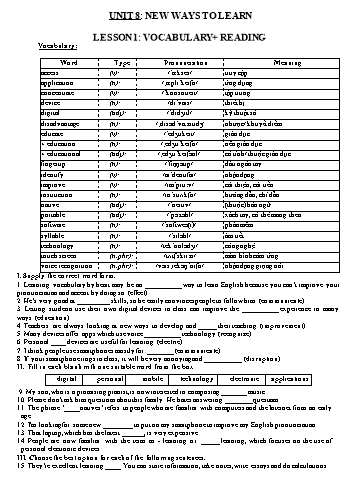
UNIT 8: NEW WAYS TO LEARN LESSON 1: VOCABULARY+ READING Vocabulary: Word Type Pronunciation Meaning access (v): /ˈækses/ truy cập application (n): /ˌæplɪˈkeɪʃn/ ứng dụng concentrate (v): /ˈkɒnsntreɪt/ tập trung device (n): /dɪˈvaɪs/ thiết bị digital (adj): /ˈdɪdʒɪtl/ kỹ thuật số disadvantage (n): /ˌdɪsədˈvɑːntɪdʒ/ nhược/ khuyết điểm educate (v): /ˈedʒukeɪt/ giáo dục + education (n): /ˌedʒuˈkeɪʃn/ nền giáo dục + educational (adj): /ˌedʒuˈkeɪʃənl/ có tính/ thuộc giáo dục fingertip (n): /ˈfɪŋɡətɪp/ đầu ngón tay identify (v): /aɪˈdentɪfaɪ/ nhận dạng improve (v): /ɪmˈpruːv/ cải thiện, cải tiến instruction (n): /ɪnˈstrʌkʃn/ hướng dẫn, chỉ dẫn native (adj): /ˈneɪtɪv/ (thuộc) bản ngữ portable (adj): /ˈpɔːtəbl/ xách tay, có thể mang theo software (n): /ˈsɒftweə(r)/ phần mềm syllable (n): /ˈsɪləbl/ âm tiết technology (n): /tekˈnɒlədʒi/ công nghệ touch screen (n.phr): /tʌtʃ skriːn/ màn hình cảm ứng voice recognition (n.phr): /vɔɪsˌrekəɡˈnɪʃn/ nhận dạng giọng nói I. Supply the correct word form. 1. Learning vocabulary by heart may be an __________ way to learn English because you can’t improve your pronunciation and accent by doing so. (effect) 2. He’s very good at _________ skills, so he easily convinces people to follow him. (communicate) 3. Letting students use their own digital devices in class can improve the __________ experience in many ways. (education) 4. Teachers are always looking at new ways to develop and _____ their teaching. (improvement) 5. Many devices offer apps which use voice __________ technology. (recognize) 6. Personal ____ devices are useful for learning. (electric) 7. I think people use smartphones mostly for _______. (communicate) 8. If your smartphone rings in class, it will be very annoying and __________. (disruption) II. Fill in each blank with one suitable word from the box digital personal mobile technology electronic applications 9. My son, who is a promising pianist, is now interested in composing _______ music. 10. Please don't ask him questions about his family. He hates answering _______questions. 11. The phrase ‘____ natives’ refers to people who are familiar with computers and the Internet from an early age. 12. I'm looking for some new ________ to put on my smartphone to improve my English pronunciation. 13. That laptop, which has the latest ______, is very expensive. 14. People are now familiar with the term m - learning or _____ learning, which focuses on the use of personal electronic devices. III. Choose the best option for each of the following sentences. 15. They’re excellent learning ____. You can store information, take notes, write essays and do calculations. 28. A smart board is more useful than a traditional board because . A. it can be connected to more electronic devices B. it can be used instead of a whiteboard, blackboard or flip chart C. it provides more interactive opportunities D. teachers can engage students to have lessons 29. Smart boards which have touch-screen technology is great because . A. you can write on it, save information, or print it later B. you can do a brainstorming session or a mind map with your classmates C. you do not need anything to write on it D. you can use a keyboard and type onto a program such as Word 30. It is great for you to run Word or PowerPoint on a smart board because . A. you don’t need to draw with the pens B. you can see the answers before the checking stage C. it can be used for grammar or vocabulary presentations D. everyone can see your presentations and take part in them 31. With the Internet access, the smart board is a wonderful tool for education because . A. students can use write on a smart board with special pens B. we can have multimedia lessons and more contributions from students C. students can download video clips or sound files from the Internet D. we can use anything that is saved on our computer 32. All of the following are true about a smart board EXCEPT . A. the lessons are more diverse and students are more active B. you do not actually need a computer to access the basic functionality C. it develops students’ English skills but not computer ones D. anything written on the board can be saved for future reference III. RELATIVE PRONOUNS. Use “which”, “that”, “who”, “whose” to fill in each gap. 9. Smartphones, laptops, and tablets are the modern devices _____ have changed the way we think. 10. Isn’t that Tim, the boy _____ father owns a red car? 11. Students _____ get below-average exam results do not have the best prospects. 12. I don’t understand the assignment _____ the professor gave us for next Monday. 13. This is the book in _____ Foster describes his experience of the war. 14. I live in a dormitory _____ residents come from many countries. 15. Tina gave her ticket to the concert to John, _____ then sold it to Nick. IV. WRITING: Combine each pair of sentences into one, using “which”, “that”, “who”, “whose”. Use comma(s) if necessary. 16. Can you see the girl? Her father is the owner of the smartphone store. ... 17. Lan can communicate with foreigners very well. She’s very good at English. ... 18. My laptop is very useful. I can’t find information for my assignment without it. ... 19. I use this tablet to download essential materials every day. It was bought by my father. ... 20. She doesn’t need to go to the library to borrow those books. They are free on the Internet. ... 21. My English audio files are stored in my smartphone. They help me to improve my listening skills. ... 22. My teacher is very strict. She doesn’t encourage us to use e-dictionaries. ... 23. With a laptop connected to the Internet, I can look up unknown words. They are unexplained sufficiently in the paper dictionary. . V. MULTIPLE CHOICE. Choose the best answer. 24. “Who's that over there?" - "Oh, it's our new teacher, ____ just started work today." A. that B. who he C. which he D. who 25. "Which CD did you get Marcus in the end?" – "I got him the one ____ said he really wanted to hear." A. that B. who he C. whose D. which he 26. “Who did you send a Valentine's card to?" - "I'm not telling you, but it was someone ____ name begins with “B”.” A. which B. who her C. whose D. whose her 27. "Why don't we go to Lionel's for dinner tonight?” - “Is that the new restaurant ____ has just opened on the other side of town?" A. which B. where C. that it D. which it 28. What do you want to do this summer?” – “I think we should go somewhere ____ has plenty of sun and sand." A. who B. where C. when D. that 29. Smartphones, laptops and tablets are the modern devices ____ have changed the way we think. A. what B. Ø C. whose D. that 30. Students use smartphones to record their phone calls, ____ they later share with the class. A. Ø B. that C. which D. whose 31. A tablet is perfect for people ____ work is to draw and write. A. who B. Ø C. which D. whose 32. You can access the Internet, download programs and information ____ can help you understand the material and widen your knowledge. A. what B. that C. Ø D. who 33. My teacher, ____ has been teaching for 25 years, finds it hard to make use of electronic devices in her teaching. A. she B. who she C. who D. whose UNIT 8: NEW WAYS TO LEARN LESSON 3: PRACTICE TEST Choose the word whose underlined part is pronounced differently from that of the rest in the following questions. 1. A. software B. aware C. cigarette D. careful 2. A. portable B. organic C. import D. opportunity Choose the word that differs from the other three in the position of primary stress in the following questions. 3. A. instruction B. instagram C. installment D. insurance 4. A. recognize B. realize C. reconnect D. reference Choose the best option. 5. Most computers have enough ____ to store a vast amount of information. A. database B. document C. memory D. word processor 6. You can’t get into the Internet unless your computer has a(an) ____. A. access B. terminal C. web page D. modem 7. Many people only use their computer as a ____. All they do is to write letters and reports on it. A. word processor B. template C. document D. spreadsheet 8. The World Wide Web is made up of millions of ____ created by anybody from multi-media corporations to ordinary people like you and me. A. newsgroups B. chatrooms C. users D. sites 9. On the web you can read ____ newspapers or magazines; you can watch videos, download music or buy anything. A. virtual B. online C. digital D. offline 10. I went to classes two evenings a week and I was surprised at how quickly I ____ progress. A. had B. made C. did D. produced 11. If you're not sure what something means, __ in your dictionary or use your electronic dictionary for help. A. check up B. look up C. translate D. interpret 12. Whenever you hear a new word that you think is important, ____ in your notebook. A. keep it down B. put it down C. write it down D. spell it down 13. She had to ____ her First Certificate Exam three times. A. study B. take C. make D. do 14. Like children elsewhere, children in the US have greatly benefited ____ modern technology. A. of B. from C. in D. with 15. "May I use your tablet for a while, pleaser" – “____” A. No way, It cost a fortune! B. I'm so sorry, I'm using it myself. C. Stay away from it! D. No, it's busy now. 16. .“ ____" - "I hate it, but I have to do it.” A. How do you feel about learning English? B. How do you learn English? C. Is English important in your country? D. Is English easy to learn? 17. “Hi, Sarah. What are you studying?" - "English, We have a test tomorrow” – “____” "Thank you. I'm going to need it!" A. Oh, really? B. Oh, good luck! C. Oh, lucky you. D. Oh, luckily. 18. Mr Forbes teaches a class for students ____ native language is not English. A. which B. who C. whose D. those who 19. I have just found the book ____. A. you were looking for B. which you were looking C. for that you were looking D. you were looking 20. I don't understand the assignment ____ the professor gave us last Monday. A. which B. that C. Ø D. All are correct 21. Students ____ get below-average exam results do not have the best prospects. A. whose B. who C. Ø D. All are correct 22. I live in a dormitory ____ residents come from many countries. A. where B. which C. in where D. whose 23. Some students prefer a strict teacher. This teacher tells them exactly what to do.
File đính kèm:
- on_tap_kien_thuc_mon_tieng_anh_10_unit_8_new_ways_to_learn.doc

