

Ôn tập kiến thức môn Tiếng Anh 11 - Unit 9: Cities of the future
A. REVIEW OF VOCABULARY
B. PRACTICE
Mark the letter A, B, C, or D to indicate the word whose underlined part differs from the other three in pronunciation in each of the following questions.
1. A. climate B. capable C. global D. available
2. A. commercial B. electricity C. advanced D. processing
3. A. urban B. infrastructure C. quality D. inhabitant
Mark the letter A, B, C, or D to indicate the word that differs from the other three in the position of primary stress in each of the following questions.
4. A. underground B. contrary C. quality D. improvement
5. A. renewable B. sustainable C. infrastructure D. environment
6. A. influential B. opportunity C. temperament D. expectation
 14 trang
01/12/2025
990
14 trang
01/12/2025
990
Bạn đang xem tài liệu "Ôn tập kiến thức môn Tiếng Anh 11 - Unit 9: Cities of the future", để tải tài liệu gốc về máy hãy click vào nút Download ở trên.
Tóm tắt nội dung tài liệu: Ôn tập kiến thức môn Tiếng Anh 11 - Unit 9: Cities of the future
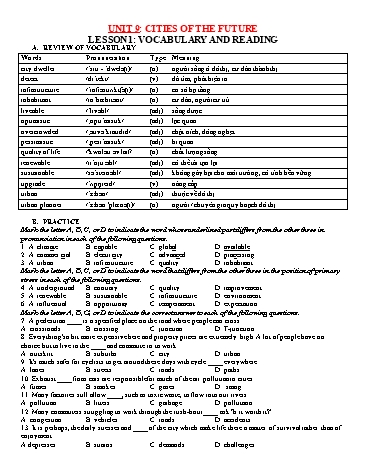
 UNIT 9: CITIES OF THE FUTURE
 LESSON 1: VOCABULARY AND READING
 A. REVIEW OF VOCABULARY
Words Pronunciation Type Meaning
city dweller /ˈsɪti - ˈdwelə(r)/ (n) người sống ở đô thị, cư dân thành thị
detect /dɪˈtekt/ (v) dò tìm, phát hiện ra
infrastructure /ˈɪnfrəstrʌktʃə(r)/ (n) cơ sở hạ tầng
inhabitant /ɪnˈhæbɪtənt/ (n) cư dân, người cư trú
liveable /ˈlɪvəbl/ (adj) sống được
optimistic /ˌɒptɪˈmɪstɪk/ (adj) lạc quan
overcrowded /ˌəʊvəˈkraʊdɪd/ (adj) chật ních, đông nghẹt
pessimistic /ˌpesɪˈmɪstɪk/ (adj) bi quan
quality of life /'kwɒləti əv laɪf/ (n) chất lượng sống
renewable /rɪˈnjuːəbl/ (adj) có thể tái tạo lại
sustainable /səˈsteɪnəbl/ (adj) không gây hại cho môi trường, có tính bền vững
upgrade /ˈʌpɡreɪd/ (v) nâng cấp
urban /ˈɜːbən/ (adj) thuộc về đô thị
urban planner /ˈɜːbən 'plænə(r)/ (n) người / chuyên gia quy hoạch đô thị
 B. PRACTICE
Mark the letter A, B, C, or D to indicate the word whose underlined part differs from the other three in
pronunciation in each of the following questions.
1. A. climate B. capable C. global D. available
2. A. commercial B. electricity C. advanced D. processing
3. A. urban B. infrastructure C. quality D. inhabitant
Mark the letter A, B, C, or D to indicate the word that differs from the other three in the position of primary
stress in each of the following questions.
4. A. underground B. contrary C. quality D. improvement
5. A. renewable B. sustainable C. infrastructure D. environment
6. A. influential B. opportunity C. temperament D. expectation
Mark the letter A, B, G, or D to indicate the correct answer to each of the following questions.
7. A pedestrian ____ is a specified place on the road where people can cross.
A. crossroads B. crossing C. junction D. T-junction
8. Everything's a bit more expensive here and property prices are extremely high. A lot of people have no
choice but to live in the ____ and commute in to work.
A. outskirt B. suburbs C. city D. urban
9. It's much safer for cyclists to get around these days with cycle ____ everywhere.
A. lanes B. streets C. roads D. paths
10. Exhaust ____ from cars are responsible for much of the air pollution in cities.
A. fumes B. smokes C. gases D . smog
11. Many factories still allow ____, such as toxic waste, to flow into our rivers
A. pollution B. litters C. garbage D. pollutants
12. Many commuters struggling to work through the rush-hour ____ ask 'Is it worth it?'
A. congestion B. vehicles C. roads D. accidents
13. It is perhaps, the daily stresses and ____ of the city which make life there a matter of survival rather than of
enjoyment.
A depresses B. strains C. demands D. challenges 32. “What a boring lecture!" - “____”
A. Yes, it was dull, wasn't it? B. I don't agree. It's dull.
C. It's interesting, wasn't it? D. I'm sorry not.
33. “I believe people will have a better life in the future.” - “____ Life will be more enjoyable than it is today,
won't it?”
A. No, I don't think so. B. Not exactly. C. Yes, I agree. D. You can't be right.
34. ” ____” – “That's right. London will be cleaner and more sustainable.”
A. This means there'll be no pollution, will there?
B. This means there'll be no pollution, won't there?
C. This means there won't be no pollution, will there?
D. This means there'll be no pollution, doesn't it?
35. "What's the weather forecast?” – “____”
A. Don't forget your raincoat, will you?
B. Don't forget your raincoat, do you?
C. It's going to rain. Don't forget your raincoat, will you?
D. It's going to rain. Don't forget your raincoat, do you?
36. “Global warming will continue to be a big threat to life on earth.” – “____”
A. We can't afford to ignore its effects any longer.
B. Then we can't afford to ignore its effects any longer, can we?
C. So don't ignore its effects any longer.
D. Please don't ignore its effects any longer.
37. “Oh, I'm sorry! Am I disturbing you?” – “____”
A. Sure, you're a real nuisance! B. You're such a pain in the neck!
C. No, never mind. D. No, you're OK.
38. “In 2050, London won't be a good place to live in, will it?” – “____”
A. Exactly, it will be. B. On the contrary, it will be.
C. I'm sorry, it will be. D. Unfortunately, it will be.
39. “I'm going to the supermarket now. Do you need anything?” – “____”
A. Get me some cheese and some oil, may you?
B. Get me some cheese and some oil, can't you?
C. Get me some cheese and some oil, could you?
D. Get me some cheese and some oil, couldn't you?
40. “I don't have any plans for tonight.” – “____”
A. Why not going to the cinema with me? B. I suggest to go to the cinema.
C. Let's go to the cinema, shall we? D. What if going to the cinema?
C. READING: Read the following passage and mark the letter A, B, C, or D to indicate the correct word or
phrase that best fits each of the numbered blanks.
 MARRAKECH
Where can you go in January for almost guaranteed sunshine – without travelling for most of the day to get
there? The answer is Marrakech in Morocco, a four-hour (1) ____ from Britain, where the average temperature
is a pleasant 66°F.
Marrakech is a city of (2) ____ beauty, with its pink buildings and green palm trees contrasting with the snow-
covered (3) ____ of the Atlas Mountains in the distance. For tourists, there's the added attraction of excellent
food at reasonable prices, and high quality accommodation, such as Hotel La Momounia, (4) ____ as one of the
top hotels in the world.
(5) ____ Marrakech is one of Morocco's busiest and most modern cities, the influence of the Middle Ages is
still very evident. Sightseers can admire the battlements, towers, and mosques, which were built (6) ____
centuries ago. And forget about shopping malls – for perfumes, fabrics, antiques, spices and crafts, (7) ____ the
‘souks’, open-air market places where you'll almost (8) ____ find something to take back home. B. Rawalpindi would be the regional centre with industry and commerce.
C. The national park would provide space for agriculture.
D. Islamabad would play the most important role of all.
40. What does the passage primarily describe?
A. The history of the two capital cities of Pakistan.
B. The disappearance of the old capital city of Pakistan.
C. The reasons why Islamabad became the new capital city of Pakistan.
D. The choice and development of Islamabad as the modern capital of Pakistan. Ex: Take your seat, wont you? (Mời ông ngồi).
+ Có phần đuôi là “will you?” khi cầu phát biểu diễn tả lời yêu cầu hoặc mệnh lệnh phủ định
Ex: Open the door, will you? ( Xin vui lòng mở cửa)
 Don't be late, will you ? (Đừng đi trễ nha)
3. Phần đuôi của cậu bắt đầu bằng “Lets ..” là “shall we?”
Ex: Let's go swimming, shall we?
- Nhưng phần đuôi của “Let me, ..... will you”
4. Đại từ bất định:
- Khi chủ ngữ là Đại từ bất định chỉ vật: Nothing, anything, something everything được thay thế bằng “It” ở
câu hỏi đuôi.
Ex: Everything will be all right, won't it?
- Khi chủ ngữ là Đại từ bất định chỉ người: No one, nobody, anyone, anybody, someone, somebody,
everybody, everyone được thay thế bằng “They” trong câu hỏi đuôi.
Ex: Someone remembered to leave the messages, didn't they?
Note: Nothing, Nobody, No one được dùng trong mệnh đề chính, động từ câu hỏi đuôi sẽ phải ở dạng khẳng
định. (Vì Nothing, Nobody, No one có nghĩa phủ định)
Ex: Nothing gives you more pleasure than listening to music, does it?
5. This/ That được thay thế là “It”.
Ex: This won't take long, will it?
6. These/ Those được thay thế là “They”.
Ex: Those are nice, aren't they?
7. Khi trong câu nói có từ phủ định như: seldom, rarely, hardly, no, without, never, few, little... phần đuôi
phải ở dạng khẳng định.
Ex: He seldom goes to the movies, does he?
8. Nếu câu phát biểu có dạng:
- You’d better → câu hỏi đuối sẽ là: hadn't you?
- You’d rather → câu hỏi đuôi sẽ là: Wouldn’t you?
- You used to → câu hỏi đuôi sẽ là: didn’t you?
- S + ought to + V, oughtn't + S?
9. Câu đầu là “wish’ thì ta dùng “May” trong câu hỏi đuôi.
Ex: I wish to study English, may I?
10. Chủ ngữ là ONE ta dùng “you” hoặc “one”.
Ex: One can be one's master, can't you/one?
11. Câu cảm thán: Lấy danh từ trong câu đổi thành đại từ, [to be] dùng “is, am, are”.
Ex: - What a beautiful dress, isn't it?
 - What a stupid boy, isn't he?
 - How intelligent you are, aren't you?
12. Câu đầu có “It seems that + mệnh đề” ta lấy mệnh đề làm câu hỏi đuôi.
Ex: It seems that you are right, aren't you?
13. Chủ từ là mệnh đề danh từ: Dùng “it”
Ex: - What you have said is wrong, isn't it?
 - Why he killed himself seems a secret, doesn't it?
14. Câu đầu có I + các động từ sau: think, believe, suppose, figure, assume, fancy, imagine, reckon,
expect, seem, feel + mệnh để phụ: Ta lấy mệnh phụ làm câu hỏi đuôi.
Ex: - I think he will come here, won't he?
 - I don't believe Mary can do it, can she?
Note: - Mệnh đề chính có not thì vẫn tính như ở mệnh để phụ.
 - Cùng mẫu này nhưng nếu chủ từ không phải là I thì lại dùng mệnh đề đầu làm câu hỏi đuôi. 24. We never enjoy our city break, ____?
A. do we B. don't we C. have we D. haven't we
25. There will be more and more megacities in the world,
A. will it B. won't it C. will there D. won't there
Mark the letter A, B, C, or D to indicate the underlined part that needs correction in each of the following
questions.
26. Won't you be a lot happier if Dad came home this weekend?
 A B C D
27 Should Jade gets to interview a famous politician, she will ask lots of difficult questions.
 A B C D
28. If her condition should improve, we inform you immediately.
 A B C D
29. I don't want a brother or sister, unless it will happens, of course.
 A B C D
30. If you meet John, will tell him I want to see him.
 A B C D
31. None of your friends really enjoyed themselves at the party, didn't they?
 A B C D
32. If you borrow my coat, don't get it dirty, can you?
 A B C D
33. You never work more than you have to, do you?
 A B C D
34. You made no effort to make friends with Darren, didn't you?
 A B C D
35. You sent that letter I gave you, haven't you?
 A B C D
Mark the letter A, B, C, or D to indicate the sentence that is closest in meaning to each of the following
questions.
36. Water always boils when you heat it long enough.
A. If heated long enough, water boils. B. If water is heated long enough, it boils.
C. If you heat water long enough, it boils. D. All are correct.
Exercise 14. Mark the letter A, B, C, or D to indicate the sentence that best combines each pair of sentences
in the following questions.
37. Researchers are developing low-cost devices. These devices can detect water pollutants in rivers and lakes.
A. Researchers are developing low-cost devices that can detect water pollutants in rivers and lakes.
B. Researchers are developing low-cost devices to detect water pollutants in rivers and lakes.
C. Researchers are developing low-cost devices so that they can detect water pollutants in rivers and lakes.
D. Researchers are developing low-cost devices who can detect water pollutants in rivers and lakes.
38. Urban planners carry out projects to develop a city. They look at the needs of local people and the
environment when they do this.
A. While carrying out projects to develop a city, urban planners look at the needs of local people and the
environment when they do this.
B. While carrying out projects to develop a city, urban planners look at the needs of local people and the
environment.
C. If they carry out projects to develop a city, urban planners look at the needs of local people and the
environment when they do this.
D. As carrying out projects to develop a city, urban planners look at the needs of local people and the
environment.
39. Most Superstar City Dwellers are quite happy with their life and work. Barbara and Mark are quite happy,
too.
File đính kèm:
- on_tap_kien_thuc_mon_tieng_anh_11_unit_9_cities_of_the_futur.docx

